Long ago, when the Lord created the world, He began distributing lands among the nations. Every nation received land from God. Only the Georgians arrived last and were late.
The Lord was upset and asked the Georgians: “Why did you take so long?” The Georgians replied: “We are an unhurried people. We walked without rushing, admired the newly created world, held feasts along the way, drank wine and made toasts. Our toasts are long, so we did not arrive on time.” “And what were you drinking to, my children?” God asked in surprise. The Georgians honestly answered: “To our homeland, to mothers and to God.” And indeed, these are among the essential toasts in Georgia.
God thought for a moment, but then the Virgin Mary spoke in defense of the Georgians: “Give them land, Lord, for they are worthy.” God agreed and made a generous gift — He gave the Georgians the very piece of land He had reserved for Himself.
“Remember,” He said, “this land is special. It is beautiful beyond comparison. People will always admire it. Protect your land and be happy.”
And so it happened. For many centuries humanity has admired Georgia, and Georgians care for their homeland and protect it from enemies. And just as in those distant times, they raise toasts to their homeland, to mothers and to God.
Georgia is a very small country, roughly the size of Ireland. If you subtract Abkhazia and South Ossetia from its territory, it becomes comparable to the Netherlands. Georgia borders Russia, Azerbaijan, Armenia and Turkey. During Soviet times the country was a fashionable holiday destination. Later it went through several wars and political upheavals, which made it less visited and little studied for Russian residents. The war of 2008 and the anti-Georgian propaganda that followed led Russian tourists to avoid traveling to Georgia for several years, choosing Abkhazia instead, although it was more expensive and less safe. Foreign tourists, on the contrary, traveled to Georgia and avoided Abkhazia. Over time, the number of Russian tourists increased, and after the 2012 elections tourism traffic began to revive and even Moscow travel agencies cautiously started to show interest in Georgia. After the tensions between Russia and Turkey, trips to Georgia became extremely fashionable, possibly losing some of their originality. But what is important is that mass low-quality tourism has not yet taken over Georgia.
Georgia is a mountainous, warm and relatively affordable country — comparable in price to Turkey, Serbia and Morocco. Summers can be quite hot, but September–October is the best season. Prices are generally low and fairly stable, the overall standard of living is also modest, but Georgia is a country gradually changing for the better. From 2010 to 2013 improvements were visible every year. Roads were built, internet access expanded, national parks and archaeological sites were reconstructed, churches were restored and more. There is still much that does not yet exist here, but it should be understood that in 2004 the country practically started from scratch, while at the same time dealing with the problem of hundreds of thousands of refugees.
Text authors:
- A. Mukhranov
- v-georgia
Geography of Georgia
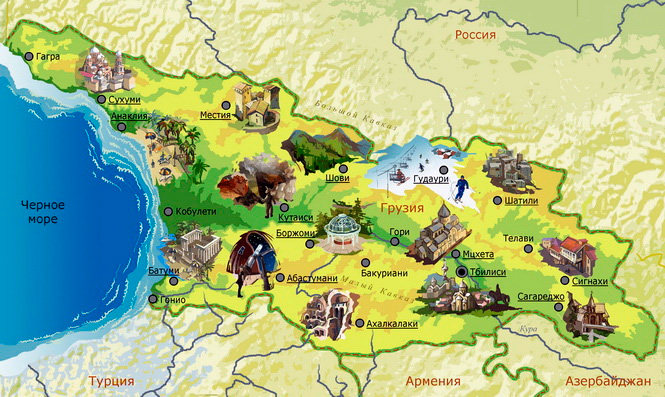
The Republic of Georgia (Georgian: Sakartvelo) — is a state in the western part of Transcaucasia on the eastern coast of the Black Sea. Until 1991 it was part of the USSR; since 1991 it has been an independent state. It borders Russia to the north, Azerbaijan to the east, and Armenia and Turkey to the south. The total area is 69.7 thousand sq. km., including Abkhazia (area 8.6 thousand sq. km.) and South Ossetia (area 3.9 thousand sq. km.), which unilaterally declared their separation from Georgia. Georgia considers the territories of Abkhazia and South Ossetia to be occupied and part of Georgia.
NATURE
RELIEF
Two thirds of Georgia’s territory are occupied by mountains. In the north stretches the Greater Caucasus mountain system with elevations up to 4500–5000 m above sea level. The highest point in Georgia is Mount Shkhara (5068 m). In the upper parts of the Greater Caucasus ranges there are 786 glaciers with a total area of 556 sq. km. The central watershed zone of the mountains includes well-known mountain passes: Cross Pass (2384 m), Mamison Pass (2829 m), Roki Pass (2996 m), along which tourist routes pass.
The curtain-like ridges of the southern slope of the Greater Caucasus are separated by deep river valleys. Here, in a warm and humid climate, karst is widely developed in carbonate rocks. Only on the low ridges (below 1000 m above sea level) there are more than 470 karst caves, including the largest — New Athos Cave (3.3 km long, area approx. 50 thousand sq. m). On the southern slope of the Greater Caucasus there are large deposits of manganese, lead-zinc and silver-lead ores, barite, coal, and marble.
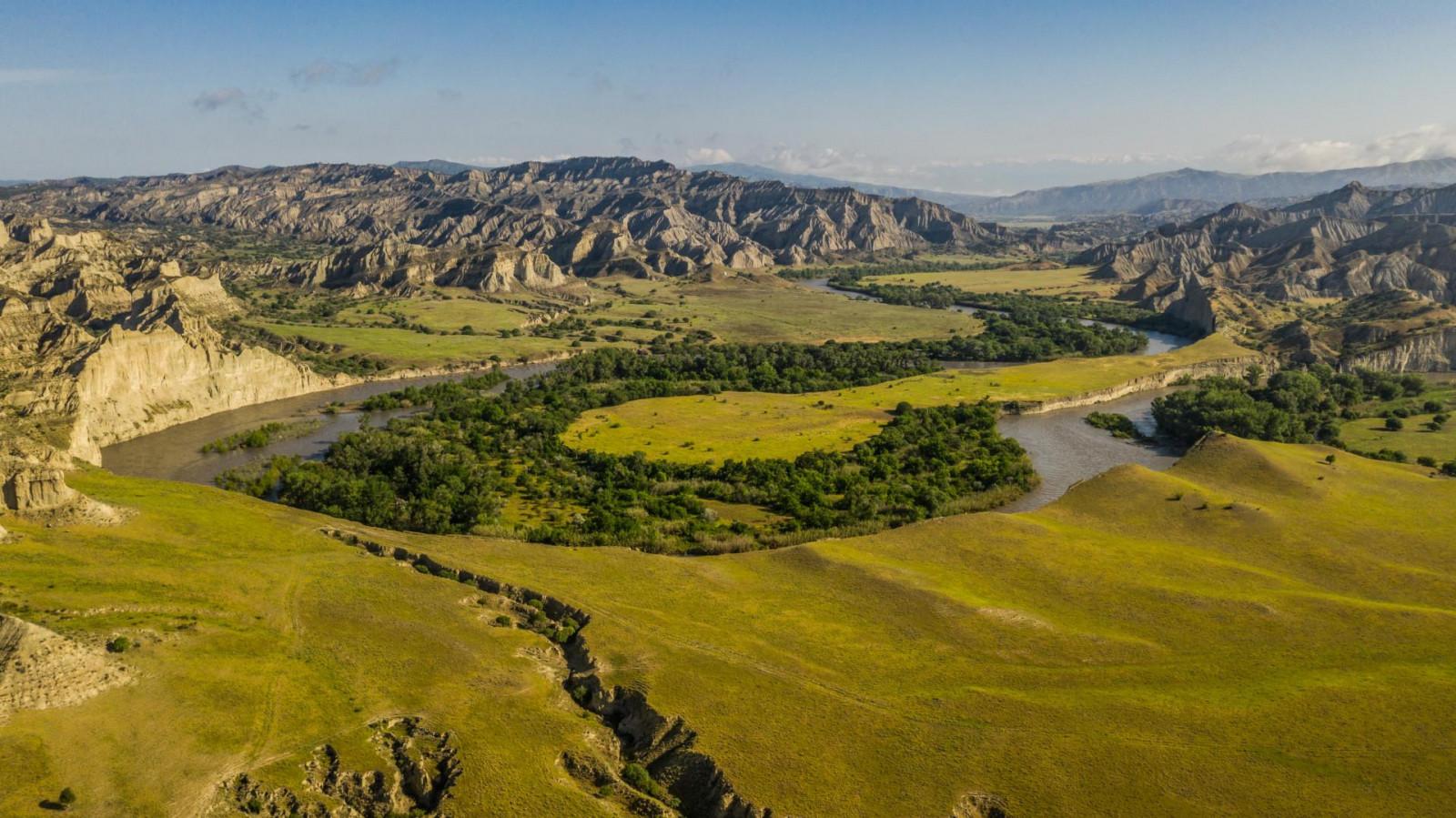
Between the Greater and Lesser Caucasus lies a latitudinal zone of intermountain basins, where Georgia’s most fertile lands are concentrated. In the west stands out the heavily marshy Kolkheti Lowland; in the east — plains where the historical provinces of Imereti, Kartli, and Kakheti were formed long ago. From the east, the Kolkheti Lowland is closed by the Likhi (Surami) Range, which serves as a natural boundary separating western Georgia from eastern Georgia. East of the Likhi Range are the Kartli Plain, the Iori and Shiraki plateaus (with elevations up to 500–700 m) and the Alazani Valley (up to 500 m). Oil deposits have been explored within the Kakheti Plain, and oil and peat deposits within the Kolkheti Lowland.
The mountains of the Lesser Caucasus are separated from the intermountain basin zone by the Meskheti and Trialeti ranges. The average elevations of the mountains in the south of the country are 2000–3000 m above sea level. Within the South Georgian (Javakheti) Highland there are lava plateaus composed of volcanic tuffs and lakes of volcanic origin (Paravani, Khozapini, etc.).
In addition to the minerals mentioned above, Georgia has deposits of copper, talc, diatomite, marl, limestone, and refractory clays. In many areas of Georgia there are mineral springs used in balneology (Borjomi, Tskhaltubo, Menji, Avadhara, Sairme, etc.).
The territory of Georgia is characterized by increased seismic activity; in some areas earthquakes of 5–7 points occur (especially in the eastern regions). Mountain areas in the modern era tend to uplift (more than 10 mm per year), while lowlands tend to subside. The Kolkheti Lowland is distinguished by especially high subsidence rates (up to 1.3 mm per year). Many coastal settlements of ancient times are now flooded.
WATER RESOURCES.
Georgia has about 25 thousand rivers, many of which are used for energy production and irrigation. They are fed mainly by melted snow and glacial waters as well as atmospheric precipitation. In foothill regions composed of carbonate rocks, groundwater plays a significant role in feeding rivers. Rivers in Western Georgia are full-flowing throughout the year, while in the east river runoff decreases in winter and summer.
Most rivers (Rioni, Inguri, Bzyb, Keda, etc.) belong to the Black Sea drainage basin; a smaller part belongs to the Caspian Sea basin (the Kura with tributaries Alazani, Iori, Aragvi, Liakhvi, Khrami). The longest and most water-rich river of Western Georgia is the Rioni (327 km), which originates in the Greater Caucasus and flows into the Black Sea near Poti. The Kura River (in Georgian Mtkvari) begins in the mountains of northern Turkey, crosses southern and eastern Georgia, and flows into the Caspian Sea on the territory of Azerbaijan.
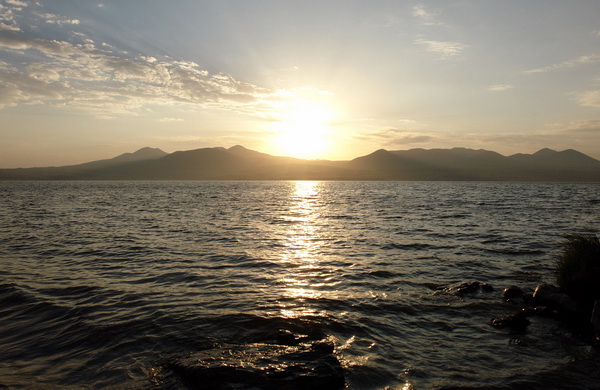
Lakes in Georgia are few. The largest are Paravani (37.5 sq. km) and Tabatskuri (14.2 sq. km) on the Javakheti Highland, and Paliastomi (18.2 sq. km) on the Black Sea coast, at the mouth of the Rioni River.
SOILS.
Three main soil-geographical regions are distinguished in Georgia: western, eastern, and southern. In the lowlands of the western region (between the Likhi Range and the Black Sea), peat soils suitable for growing corn are typical; in the foothills, subtropical red and yellow soils are widespread, ideal for growing grapes, tea, and tobacco; in higher areas of Samegrelo, Abkhazia, and Svaneti — brown or carbonate forest and mountain soils. In the eastern region ancient alluvial soils prevail. On the Kvemo Kartli Plain chestnut soils are widespread, suitable for cultivating vegetables, fruit, and grain crops. Chernozems and brown soils of the Kakheti Plain are used mainly for grain crops and vineyards, although in the areas of Gardabani and Sagarejo (southeast of Tbilisi) these soils are low in fertility due to the arid climate. The southern region is confined to the foothills and southern slopes of the Lesser Caucasus and the South Georgian Highland. It is characterized by a combination of brown and mountain-meadow soils used for cultivating grain crops, vegetables, and, to a lesser extent, grapes.
FLORA.
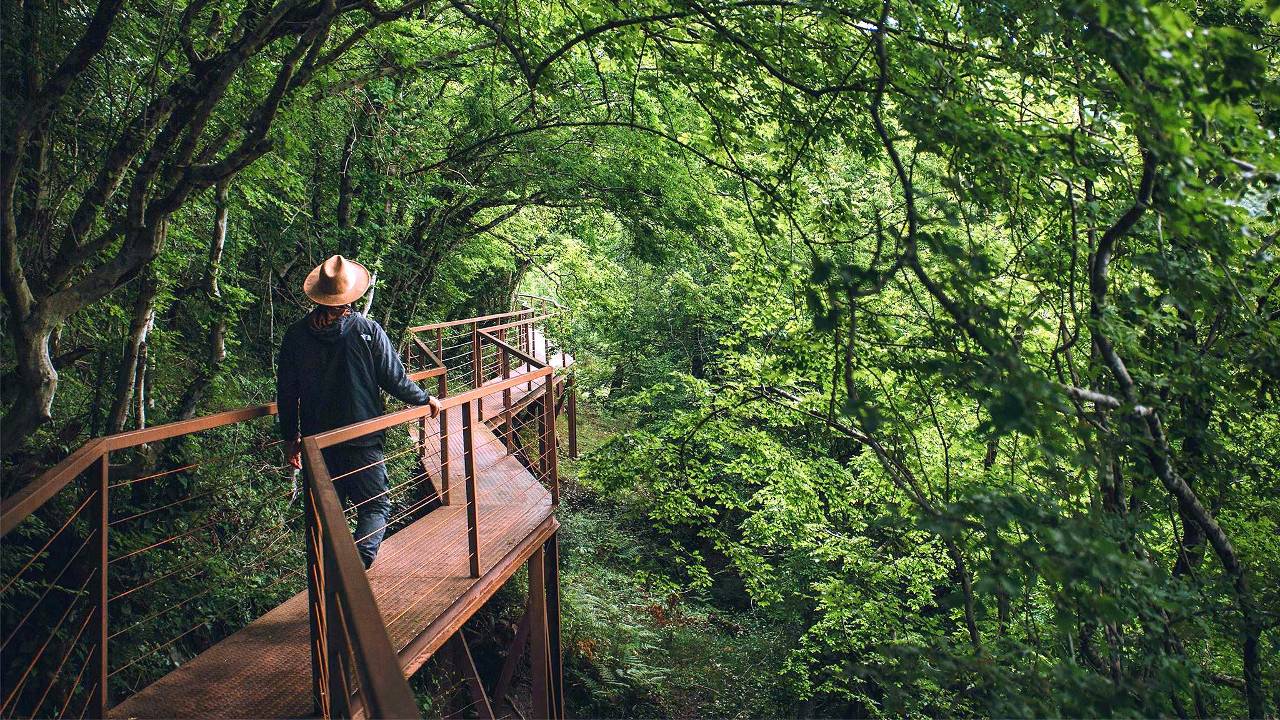
The flora of Georgia is extremely diverse: more than 5,000 species of flowering plants are found here alone. Depending on climatic features and altitude, several zones and vertical vegetation belts are distinguished (from steppe to alpine).
Forests are mainly distributed in mountainous areas and occupy about one third of the country’s territory. In western Georgia they descend almost to the sea, while in the east their lower boundary lies at elevations of 600–800 m above sea level. The forests of Western Georgia are particularly rich and diverse. In their lower belt (up to 1000–1200 m) broad-leaved species dominate (oak, hornbeam, chestnut, maple, beech, etc.) with evergreen undergrowth of Pontic rhododendron, cherry laurel, boxwood, Colchic holly, butcher’s broom, Caucasian blueberry. This type of forest, called Colchian, is characterized by an abundance of lianas — ivy, clematis, smilax; in places it becomes impassable. In the marshy forests of the Kolkheti Lowland alder predominates and there is almost no undergrowth. In some areas of the Abkhazian coast endemic species occur, for example the Pitsunda pine — a relic of the Tertiary Crimean-Caucasian flora. For thousands of years grapes and fruit crops have been cultivated in the valleys.
In Western Georgia, above the Colchian forest belt and up to the upper forest limit (1700–1800 m), mixed forests are widespread, combining beech and spruce-fir stands, more rarely pine forests. At the upper forest boundary birch groves with rowan and thickets of rhododendron are found.
The forests of Eastern Georgia are floristically less rich. In the upper mountain belt (up to 2300–2400 m), spruce-fir forests are common west of the Ksani River, while further east only pine and pine-birch forests occur. Below, coniferous forests give way to beech, then to oak-hornbeam forests. In the far east of the country small areas of dry steppes (feather grass and fescue types with mixed herbs) and xerophytic sparse woodlands occur with species such as hackberry, pistachio, pomegranate, Christ’s thorn. Even more limited are wormwood semi-deserts with kochia and saltwort. In the valleys of the Kura, Alazani, Iori and other rivers, floodplain tugai forests of aspen, willow, silver poplar, oak and cornelian cherry have survived.
Subalpine and alpine meadows in western Georgia rise to 2800–3000 m, in the east — up to 3600 m above sea level. Subalpine meadows of Western Georgia are characterized by lush tall grasses with a significant presence of umbellifers, legumes and labiates. Low-grass alpine meadows are distributed fragmentarily, alternating with stone screes, rock outcrops and glaciers.
FAUNA
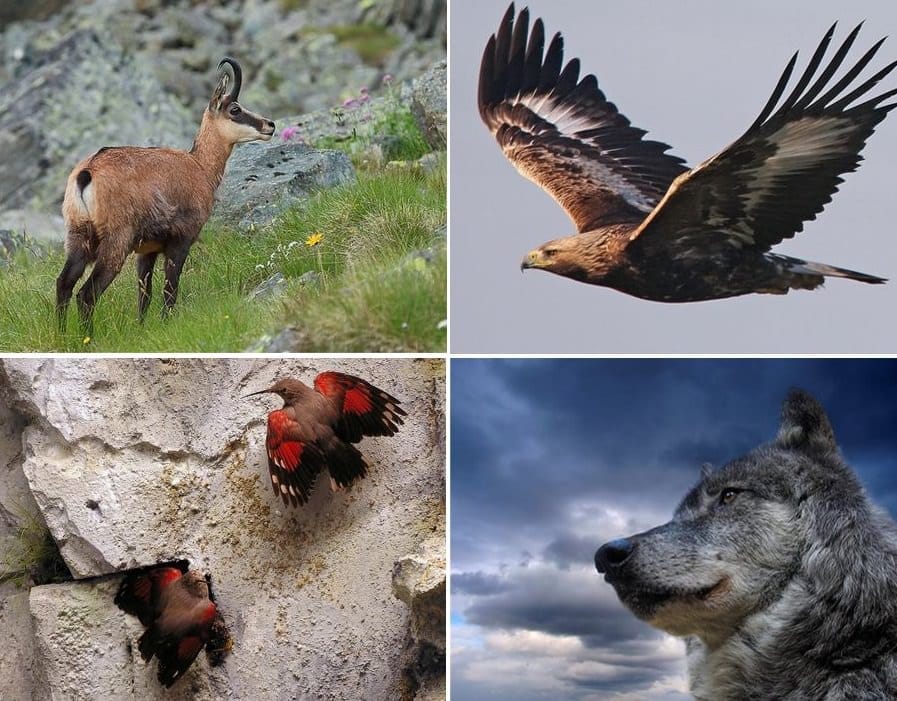
Georgia’s fauna is diverse. It includes more than 100 species of mammals, 330 species of birds and 160 species of fish. Many representatives of the fauna are endemic or semi-endemic, for example the Artvin lizard and the Kuban tur (whose horns in Georgia are used as wine vessels).
The fauna of the steppes of Eastern Georgia is quite distinctive. Until recently the goitered gazelle occurred there, now preserved only in certain areas of the Shiraki steppe. In the Gardabani steppe and the Alazani Valley the striped hyena is found. Other predators include fox, jackal and jungle cat. Wolves are common in livestock-breeding areas. Rodents typical of the steppe include jerboas, voles and hamsters. Among birds the field sparrow, grey partridge, quail and steppe eagle are common. Lizards and turtles are abundant, as well as snakes (grass snake, water snake, western sand boa, yellow-bellied racer). In the Eldari and Shiraki steppes the viper (gyurza) occurs.
The animal world of forests is the richest. In many areas the Caucasian deer, roe deer, wild boar, brown hare and squirrel are widespread; among predators — brown bear, wolf, jackal, lynx, wildcat and fox. The badger causes significant damage to agriculture. The forests of Georgia are famous for the abundance and diversity of birds. Common species include chaffinch, marsh tit, great tit, greenfinch, blackbird and others. Among birds of prey listed in the Red Book of Georgia are the bearded vulture, golden eagle, griffon vulture, black vulture and others (mainly in reserves). In some areas of Kolkheti and Kakheti pheasants can still be seen. Among reptiles, lizards, marsh turtles and snakes (grass snake, smooth snake, Caucasian viper) are most numerous.
High-mountain fauna is best preserved within the Main Caucasus Range. In its western part lives the Kuban tur, in the eastern part — the Dagestan tur. Both species descend into the forest belt in winter. The chamois is almost ubiquitous, and in the east the bezoar goat is found. Among characteristic birds of the highlands are the Caucasian black grouse, chukar and bearded vulture.
In mountain rivers and lakes trout, barbel, carp and other fish are found.
STATE OF THE ENVIRONMENT AND NATURE PROTECTION.
One of the main environmental problems is air pollution in industrial cities, especially in the metallurgical center — Rustavi. Serious concerns are caused by increased deforestation, soil erosion and pollution of the Black Sea waters. The uncontrolled use of pesticides and certain toxic chemical fertilizers is also alarming.
On the territory of Georgia, for the protection of natural complexes and preservation of biodiversity, Tbilisi National Park, 17 nature reserves and 6 sanctuaries have been established. Special attention is paid to the protection of natural relic species: Imeretian oak, Hartwiss oak, zelkova in the Ajameti Reserve within the Kolkheti Lowland, hornbeam-leaved zelkova and berry yew in the Akhmeta Reserve in Eastern Georgia, and groves of Pitsunda pine in the Pitsunda-Miussera Reserve on the Black Sea coast of Abkhazia.
Georgia participates in many international environmental protection agreements. In April 1992 the heads of government of Georgia, Bulgaria, Romania, Russia, Ukraine and Turkey signed the Convention on the Protection of the Black Sea Against Pollution. In April 1993 an intergovernmental declaration on the protection of the Black Sea was adopted in Odessa. It emphasized the need to create a system of joint management of the coastal zone and stated that Black Sea countries should develop and implement national policies within this system. The activity of this system in Georgia is supported by international organizations, including the Black Sea Environmental Programme financed by the World Bank, the United Nations Development Programme and the United Nations Environment Programme (UNEP).
POPULATION
According to the 1989 census, 5.4 million people lived in Georgia. Over the previous 10-year period the population increased by 8.7%, with the urban population growing by 16.7% and the rural population by 0.3%. About 56% of the population lived in cities (23% in Tbilisi) and about 44% in rural areas. In the post-Soviet period the population has been declining.
According to preliminary census data, in July 2003 about 4.9 million people lived in Georgia (excluding Abkhazia and South Ossetia, which did not participate in the census). The age group under 15 years accounted for 18.6% of the population, the group from 15 to 65 years — 68.4%, and those over 65 years — 13%. The birth rate in 2003 was estimated at 11.79 per 1,000 people, the death rate at 14.71 per 1,000, emigration at 2.48 per 1,000, and natural decrease at 0.59%. Infant mortality was estimated at 51.24 per 1,000 newborns. Life expectancy was 64.76 years (61.33 for men and 68.36 for women).
According to the 2013 estimate (July), 4 million 556 thousand people lived in the country. The age group under 15 years accounted for 15.4% of the population, the group from 15 to 65 years — 68.4%, and those over 65 years — 16.2%.
The birth rate in 2013 was estimated at 10.72 per 1,000 people, the death rate at 10.17 per 1,000, and emigration at 3.86 per 1,000. Infant mortality was estimated at 14.21 per 1,000 newborns. Life expectancy was 77.51 years (74.16 for men and 81.17 for women).
ETHNIC COMPOSITION.
Georgia is a multinational society. In 1989 Georgians made up 70.1% of the population (in 1979 — 68.8%). Among ethnic Georgians there are clearly distinct regional groups — Megrelians and Svans. Among national minorities, Armenians (8.1%), Russians (6.3%), Azerbaijanis (5.7%), Ossetians (3.0%), Greeks (1.9%) and Abkhazians (1.8%) stood out. In the period 1979–1989, due to assimilation and departure from Georgia, the share of almost all the listed groups decreased, with the exception of Abkhazians and Azerbaijanis.
In 2002 Georgians made up 83.8% of the population, Armenians — 5.7%, Russians — 1.5%, Azerbaijanis — 6.5%, and the rest — Ossetians, Greeks and Abkhazians — 2.5% of the population.
Abkhazians are a distinct ethnic group with their own autonomy. Ossetians are concentrated mainly within the former South Ossetian Autonomous Oblast, where in 1989 they accounted for 66.2% of the population. Outside it, most Ossetians lived dispersed throughout eastern Georgia. Adjarians have their own autonomous republic, where in 1989 they accounted for 82.8% of the population. The smallest national minorities include Jews, Assyrians, Kurds and Tatars.
CITIES.
Tbilisi, founded in the 5th century AD by King Vakhtang I Gorgasali, is located in the very center of Georgian lands, at the junction of several historical regions — Inner and Lower Kartli (Kartli), Kakheti and Javakheti. From 1801 to 1917 Tiflis (as Tbilisi was called until 1936) was the main administrative and trade center of the Caucasus region. In 1845 it became the residence of the viceroy of the Russian Empire, who governed the North Caucasus and Transcaucasia.
Modern Tbilisi has a population of 1,115 thousand people (2009). The city is constantly growing, mainly due to the influx of population from rural areas. As a result of the Georgian-Abkhaz ethnic conflict of 1993–1994, about 80 thousand refugees from Abkhazia arrived in Tbilisi.
According to the 1989 census, ethnic Georgians made up 66% of its population, Armenians — 12%, Russians — 10%, Ossetians — 3%, Kurds — 2% and Greeks — 2%. The architecture of the city reflects a rich mixture of Eastern and Western cultures. The old part of the city is characterized by winding streets, bazaars and low houses with flat roofs and carved balconies. Modern quarters have a European look: beautiful multi-storey buildings face wide boulevards and avenues lined with shady trees. Around Tbilisi significant areas are occupied by forest parks, gardens and vineyards.
Other major cities include Kutaisi (267.3 thousand inhabitants in 2002), the oldest city in the country and the regional center of Western Georgia; Rustavi (180.5 thousand), the main metallurgical center; Batumi (144.6 thousand), the capital of Adjara, the main port and oil terminal of Georgia; Gori (70 thousand), an ancient city (7th century), a railway junction; Chiatura (68.4 thousand) and Tkibuli (36.9 thousand) — centers of manganese and coal mining; Sukhumi (60.9 thousand, in 1989 — 121.4 thousand), the capital of Abkhazia and in the recent past the main resort; Poti (51.7 thousand) — a port city; Zugdidi (50.6 thousand), an industrial center; Tskhinvali (42 thousand) — the center of South Ossetia.
History of Georgia
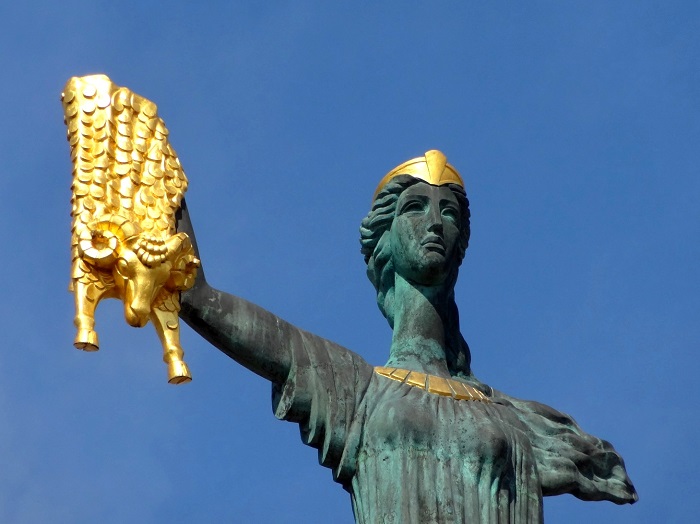
The first traces of prehistoric human presence on the territory of Georgia date back to the Middle Paleolithic. The remains of the oldest human in Eurasia — “Homo erectus georgicus” — are about 1.8 million years old.
In the early Eneolithic period, a major center of agriculture emerged in eastern Georgia. The oldest Bronze Age monuments in the Akhaltsikhe area appeared about 5,000 years ago. In the middle Bronze Age, the Trialeti region was home to a major cultural center. At the end of the Bronze Age (about 3,000 years ago), kurgan cultures spread, associated with the migration from the south of proto-Georgian tribes (Diaukhi, Tabali, Mushki and Colchians). They were skilled in iron smelting and metalworking, and their feats were reflected in Greek myths about the Golden Fleece and Prometheus. According to Greek accounts, these symbols of wealth and knowledge were located in the Caucasus. The Assyrians, who invaded the Caucasus and pushed ancient Georgian tribes northward, ruled in the 8th–7th centuries BC. Herodotus noted that the Assyrian king Sargon II resettled part of the Israeli population he had taken from Palestine in 722 BC to Colchis. The western Georgian Kingdom of Colchis was formed approximately in the 6th century BC, and the eastern Kartli (Iberian) Kingdom in the 4th century BC. Both had political and economic ties with the Greeks, the Achaemenid and Parthian states. According to Strabo and Pliny the Elder, both states flourished. Since the 4th century BC, Georgians have called themselves Kartveli, and their country Sakartvelo (“land of the Kartvelians”).
In the 1st century BC, Roman legions under the command of Pompey the Great established Roman authority in Colchis and forced Kartli to sign treaties with Rome. Around 330 AD, Christianity was introduced in Kartli, and in Western Georgia and Abkhazia in the 6th century. In 523 the Kingdom of Kartli was conquered by the Sassanids; in 562 AD the Kingdom of Colchis was annexed to the Byzantine Empire. In the early 7th century Byzantium also established control over Kartli. From the mid-7th to the 9th centuries, a significant part of Georgian lands was occupied by Arabs. Several feudal states emerged on Georgian territory: the Kingdom of Abkhazia in the west (including Abkhazia and Western Georgia), Tao-Klarjeti in the south, Kakheti and Hereti in the east, and Kartli in the central part.
MIDDLE AGES.
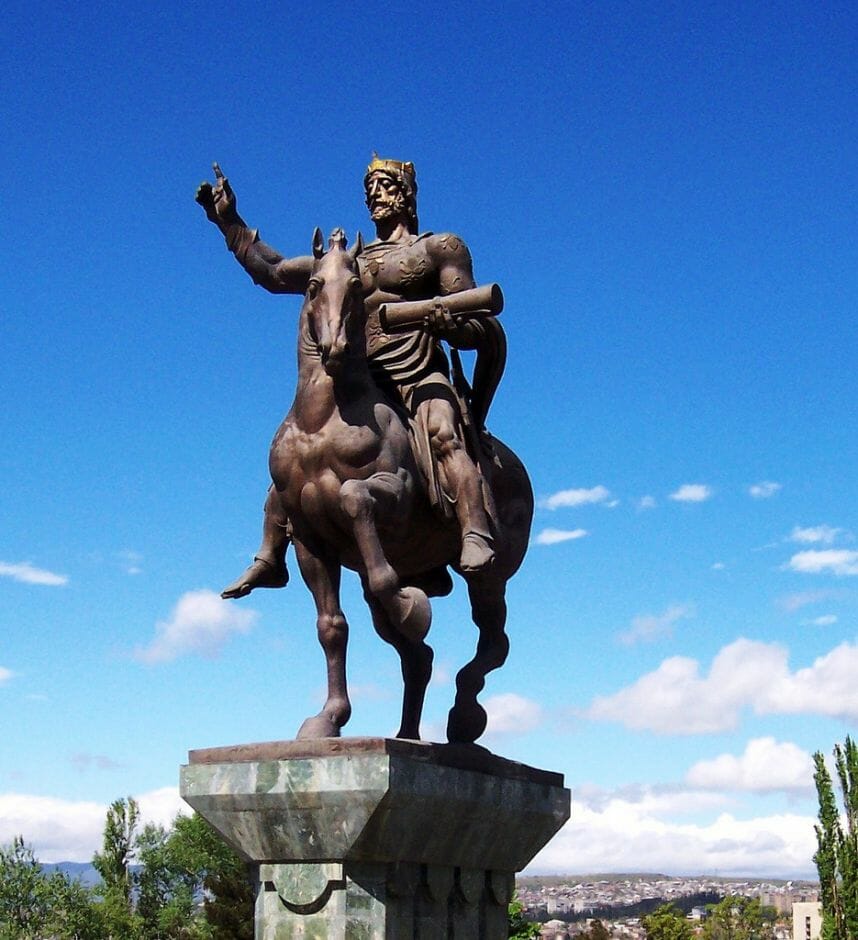
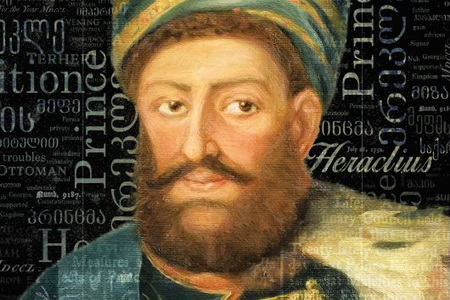
At the end of the 10th century, King Bagrat III united the eastern and western parts of Georgia into a single state (his descendants, the Bagrationi dynasty, ruled Georgia until 1801). The monarchy and united Georgia were finally strengthened under David IV the Builder (ruled 1089–1125) and his granddaughter Queen Tamar (ruled 1184–1213). The 12th century became the “Golden Age” of the country’s cultural and political development. It was the era of the flourishing Georgian academies in Gelati and Ikalto; at this time the brilliant poet Shota Rustaveli (who dedicated his epic poem “The Knight in the Panther’s Skin” to Queen Tamar) created his masterpiece; master goldsmiths Beka and Beshken Opizari were active. Numerous churches were built. Georgian warriors participated in the Crusades, and Georgian scholars were known in the monasteries of Palestine and Greece. By the beginning of the 13th century, the Georgian Kingdom, stretching from the Black Sea to the Caspian Sea, became one of the most powerful states in the region and maintained trade relations with Europe and the East. Its period of greatness ended in the 13th century when the Mongol-Tatars invaded the country. Georgia suffered particularly from the invasions of Timur’s armies at the beginning of the 15th century. Georgian kings and aristocracy failed to preserve the unity of the country, except for the short reign of George V the Brilliant (1314–1346). After the fall of Constantinople in 1453, Georgia was cut off from the Christian world and subsequently subjected to Turkish and Persian conquests. Even under such great kings as Vakhtang VI (1703–1712 and 1719–1724) and Erekle II (1744–1798), the country was unable to defend itself against raids from northern mountain tribes and Muslim forces from the south.
RUSSIAN RULE.
In 1783 Erekle II concluded a treaty with the Russian Empress Catherine II (the Treaty of Georgievsk), according to which Russia established a protectorate over the Kingdom of Kartli-Kakheti. In 1801 Russia annulled the treaty and annexed Eastern Georgia. Shortly before that, in 1800, the last king of the Bagrationi dynasty — George XII of Kartli-Kakheti — died. Western Georgia was gradually incorporated into the Russian Empire between 1803 and 1864. This process was greatly facilitated by Russia’s victories in the Russo-Persian (1804–1813 and 1826–1828) and Russo-Turkish (1806–1812 and 1828–1829) wars. Anti-Russian uprisings that periodically broke out were quickly and harshly suppressed.
In the 19th century significant changes occurred in Georgia’s social and political life. The abolition of serfdom, urban growth, improvement of the education system and industrial development strongly influenced the formation of the Georgian nation. Tbilisi (Tiflis) became the administrative and commercial center of the entire Caucasus. In 1872 a railway connection was opened between the port city of Poti and Tiflis. Communication with Black Sea ports was established. By rail peasants came to cities in search of work.
By 1905 the Georgian section of the Russian Social Democratic Labour Party (RSDLP) had become the strongest socialist organization in the Russian Empire. After the RSDLP split into Bolshevik and Menshevik factions in 1903, most Georgian Marxists joined the Mensheviks. After the overthrow of the Tsarist autocracy in 1917, power passed to the Russian Provisional Government and Georgian councils dominated by Mensheviks. Soon after the Provisional Government resigned, power in Georgia was seized by the Mensheviks. After a brief period of federation with neighboring Armenia and Azerbaijan, the Georgian government led by the Mensheviks declared the country’s independence on May 26, 1918. With Menshevik consent, German and Turkish troops occupied Georgia in June 1918; in December they were replaced by British troops, who remained until July 1920. In February 1921 the Bolsheviks staged an armed uprising and, with the support of the Red Army, overthrew the Menshevik government.
SOVIET PERIOD.
In 1921 Georgia became a Soviet republic, and in December 1922 it was incorporated into the Transcaucasian Socialist Federative Soviet Republic (TSFSR) as part of the USSR (established on December 30, 1922). In 1936 the TSFSR was abolished, and Georgia became one of the Union republics of the USSR.
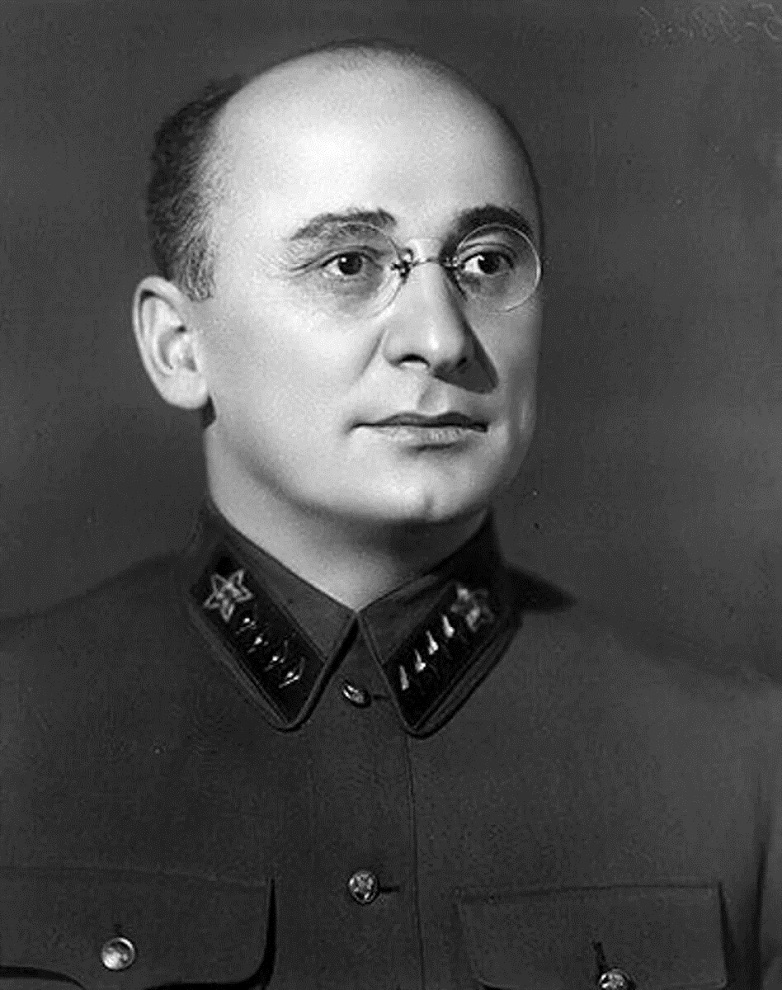
Hopes for Georgia’s political autonomy were destroyed by the policies of Joseph Stalin. In order to eliminate opposition, in 1931 Stalin appointed L.P. Beria as First Secretary of the Communist Party of Georgia, a position he held until 1938. Under Beria, collectivization in rural areas was carried out with particular brutality, and tens of thousands of people perished during mass purges (party activists, intellectuals, specialists, and anyone suspected of dissatisfaction with the Stalinist regime).
In 1944 approximately 100,000 Meskhetians (a mixed group of Muslim Georgians and Turks) were deported from southern Georgia to Central Asia.
Under N.S. Khrushchev, Georgia gained greater autonomy in managing its economy and cultural life.
In the 1970s a dissident movement emerged in Georgia led by Zviad Gamsakhurdia and Merab Kostava. The course toward perestroika proclaimed in the late 1980s by M.S. Gorbachev led to a rapid change of leaders within the Communist Party of Georgia.
In September 1990 an unofficial parliament was elected to compete with the existing one; it was called the National Congress (more than half of the electorate participated in the elections). It was dominated by members of the National Independence Party led by Irakli Tsereteli and the National Democratic Party led by Giorgi Chanturia (until January 1992 the National Congress acted as an extra-parliamentary opposition to the Supreme Council and President Gamsakhurdia).
In the multi-party elections to the Supreme Council of Georgia held on October 28, 1990, Zviad Gamsakhurdia’s coalition “Round Table – Free Georgia” won. The bloc received 54% of the vote and secured 155 of the 250 parliamentary seats. The Communist Party of Georgia gained 30% of the vote (64 seats). The All-Georgian Union of National Accord and Revival received 3.4% of the vote and did not gain any seats. In November 1990, Gamsakhurdia was elected Chairman of the Supreme Council.
Gamsakhurdia proclaimed a course toward a unitary state without autonomies. This policy was opposed by Abkhazians and residents of South Ossetia. On September 20, 1990, the South Ossetian Regional Council proclaimed the South Ossetian Soviet Democratic Republic, and on October 26 adopted its constitution. At its first session on December 11, the Supreme Council of Georgia decided to abolish South Ossetia’s autonomy, declared the conscription of Georgians into the Soviet armed forces illegal, and established an independent National Guard.
In March 1991 the Georgian government refused to conduct a referendum on the future of the USSR and instead held a referendum on Georgia’s independence. Ninety-five percent of the electorate participated, and 93% voted in favor of independence. On April 9, 1991, the Supreme Council adopted the Act on the Restoration of Georgia’s State Independence and recognized as valid the Act of Independence of 1918 and the Constitution of 1921.
INDEPENDENT GEORGIA.
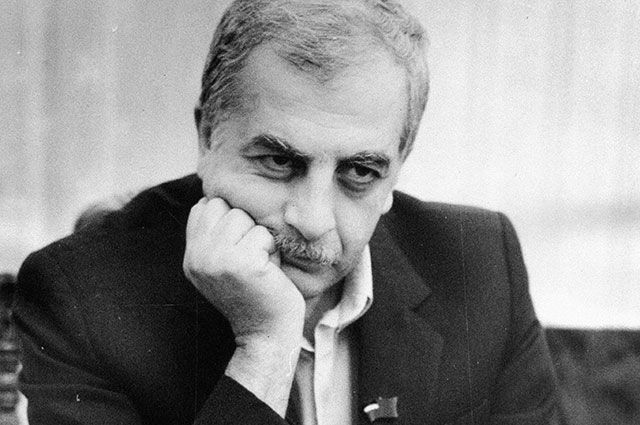
In late April 1991 the Supreme Council of Georgia adopted a new constitution and elected Zviad Gamsakhurdia as president. In the direct presidential elections on May 26, he received nearly 87% of the vote. However, in December 1991 a struggle broke out between supporters of the president and the opposition, joined by the National Guard. After several weeks of fighting in central Tbilisi, Gamsakhurdia was removed from office in January 1992 and fled the country. Power passed to a Military Council headed by Tengiz Kitovani. In March 1992 the Military Council announced its self-dissolution and the creation of a State Council composed of approximately 70 representatives from 36 opposition parties. Eduard Shevardnadze became Chairman of the State Council.
In July 1992 Shevardnadze ended the 18-month war in South Ossetia, where Joint Peacekeeping Forces (consisting of Russian, Georgian, and Ossetian battalions) were deployed. However, the war with Abkhaz forces that erupted in August 1992 could not be stopped.
In October 1992 elections were held for a new parliament. Shevardnadze was elected its chairman, receiving 96% of the vote. The cabinet appointed by Shevardnadze in late 1992 reflected the balance of political forces in the new parliament. Parliamentary factions soon divided into a majority group, supporters of Shevardnadze, and an opposition group. The majority united into the broad coalition Union of Citizens of Georgia led by Zurab Zhvania. The opposition was led by the Popular Front, the National Democratic Party, “Charter-91,” and the Ilia Chavchavadze Society. The All-Georgian Revival Union represented political forces from Adjara in Tbilisi. New political parties were formed: the Christian Democratic Union (Irakli Shengelia), the Democratic Georgian Union (Avtandil Margiani), the National Independence Party (Irakli Tsereteli), the Georgian Monarchists’ Party (Timur Jorjoliani), and the United Communist Party of Georgia (Panteleimon Giorgadze).
The parliamentary elections in November 1995 were conducted under a mixed system based on party lists and single-member districts. Ten parties that passed the 5% threshold were represented in parliament, but the most influential were three: the Union of Citizens of Georgia, the National Democratic Party, and the All-Georgian Revival Union.
In the 1999 parliamentary elections, held in two rounds on October 31 and November 14, three parties passed the 7% threshold: the Union of Citizens of Georgia, the bloc “Revival of Georgia,” and the bloc “Industry Will Save Georgia.” In addition, 12 deputies from Abkhazia and 17 independent deputies entered parliament.
In 2000 Shevardnadze was elected president for another five-year term. Opposition to the ruling party gained strength, as evidenced by the convincing victories in the 2002 local elections of the Georgian Labor Party, the bloc “National Movement – Democratic Front,” and the party “New Rights.”
CRISIS OF THE SHEVARDNADZE ADMINISTRATION AND ITS OVERTHROW.
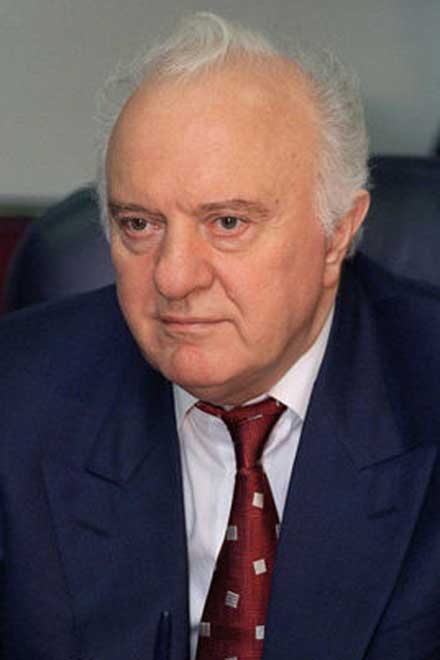
After 2000, President Shevardnadze’s position steadily deteriorated. By July 2003 Georgia’s external debt had risen to 1.75 billion USD, and the state was on the verge of insolvency. The country twice secured debt repayment deferrals from foreign creditors within the “Paris Club,” and after a failed attempt in August 2003 to push through parliament a decision on radical budget deficit reduction, the IMF announced the suspension of further assistance to Georgia. Chronic financial crisis, mass unemployment, rising poverty, and an ineffective tax system caused growing dissatisfaction among the population. About 52% of the country’s residents were living below the poverty line. At the same time, corruption reached a high level. Emigration increased (since 1991, 950,000 people had left the country, 600,000 of them to Russia). The number of internally displaced persons reached nearly 300,000.
The opposition and international organizations accused the government of human rights violations, persecution of regime opponents and national minorities, and serious irregularities during the 2002 local elections.
The country was shaken by numerous political and ethnic problems. Shevardnadze failed to achieve the return of Abkhazia and South Ossetia, which had declared separation from Georgia. In Adjara and Samtskhe-Javakheti, demands for autonomy were growing louder.
In foreign policy, Shevardnadze attempted to maintain a balance between the United States and Russia, but this became increasingly difficult. Tensions with Russia escalated due to the war in Chechnya and the situation in Abkhazia. Russian authorities accused the Georgian leadership of harboring Chechen separatists and threatened to strike “terrorist bases” on Georgian territory, in the Pankisi Gorge. Seeking to counterbalance Russian influence, Shevardnadze appealed to the United States to expand military and economic assistance, signed a strategic partnership agreement with NATO, and declared Georgia’s intention to join NATO and the European Union. He authorized the construction of the strategically important Baku–Tbilisi–Ceyhan oil pipeline across Georgian territory. In 2002 the United States sent hundreds of special military personnel to assist the Georgian army in “anti-terrorist operations” in the Pankisi Gorge.
Closer relations with the United States led to further deterioration in relations with Russia. American policymakers also became increasingly dissatisfied with the Shevardnadze administration. In spring 2003, the State Department in Washington warned that financial assistance to Georgia could be reduced and the country classified among states failing to implement “necessary” economic and political reforms.
In 2003 President Shevardnadze found himself politically isolated. The ruling bloc (Union of Citizens of Georgia) began to disintegrate. The opposition was led by Parliamentary Speaker Nino Burjanadze, who from April 2003 openly accused the government of pursuing dictatorial policies and corruption. In August she was joined by former leader of the Union of Citizens of Georgia, Zurab Zhvania. They formed the coalition “Burjanadze – Democrats.” The right-wing National Movement led by Mikheil Saakashvili also strongly opposed Shevardnadze.
Parliamentary elections were held on November 2, 2003. Authorities announced the victory of the pro-government list “For a New Georgia,” which allegedly received 21% of the vote. According to official data, 19% went to the Union of Democratic Revival led by the head of the Autonomous Republic of Adjara, Aslan Abashidze, who was considered politically close to Russia. Saakashvili’s list received 19%, while the Burjanadze–Zhvania list gained 9%.
The opposition refused to recognize the election results, accusing the government of falsification. It organized mass demonstrations in the streets of Tbilisi, which became known as the “Rose Revolution.” Security forces sided with the opposition, and opposition supporters occupied the parliament building. After two weeks of confrontation, Shevardnadze was forced on November 23 to announce his resignation. Burjanadze was declared Acting President of Georgia, and the parliamentary election results were annulled (except for the results in 75 single-member constituencies).
THE PRESIDENCY OF M. SAAKASHVILI.
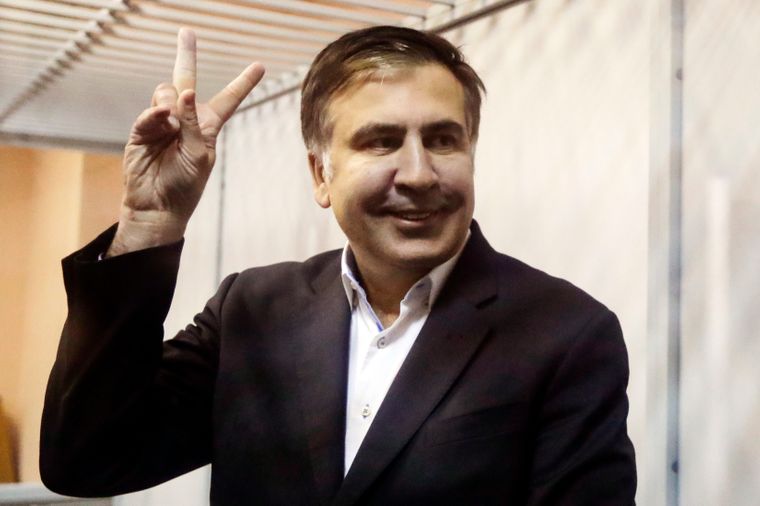
On January 4, 2004, early presidential elections were held in the country. The candidate of the victorious camp — leader of the United National Movement party, Mikheil Saakashvili — received 96.3% of the vote, while his opponent Teimuraz Shashiashvili received only 1.9%. Adjara boycotted the elections. Upon assuming office, Saakashvili appointed Zurab Zhvania as Prime Minister.
The first task of the new regime was the consolidation of power. On March 28, 2004, new elections were held for 150 parliamentary seats elected by proportional vote. The ruling bloc “National Movement – Democrats” won 67% of the vote and secured 135 seats, while 15 mandates went to the “Right Opposition” (the bloc of the “New Rights” and the conservative party “Industry Will Save Georgia”). Opposition forces (the Union of Democratic Revival, Labor Party, supporters of Gamsakhurdia, National Democrats, Traditionalists, and others) did not gain a single seat. They sharply criticized the formation of a pro-government parliament, characterizing it as a step toward a one-party system.
The leader of Adjara, Aslan Abashidze, refused to recognize the new authorities in Tbilisi, and Saakashvili increased pressure on the autonomous republic. In response to the movement of government troops, Adjara closed three bridges across the Choloki River connecting the region with the rest of Georgia. At the same time, the Georgian government supported Adjarian opposition activists who organized mass demonstrations in Batumi against the head of the autonomy. After brief resistance and Russian pressure, Abashidze was forced to flee Georgia on May 5; Adjara submitted to the central Georgian authorities.
Saakashvili’s attempts in 2004 to regain control over the breakaway regions of Abkhazia and South Ossetia led to worsening relations with Russia. The Georgian government demanded the withdrawal of Russian forces from Abkhazia. In early 2005 the Georgian parliament called for the evacuation of Russian military bases from Georgian territory. In foreign policy, the Saakashvili administration oriented itself toward the United States and NATO. The government announced its intention to carry out economic reforms in cooperation with the IMF and the World Bank.
In January 2006 the president signed a decree withdrawing Georgia from the Council of Defense Ministers of the CIS countries. Georgia’s foreign policy course shifted toward integration into NATO and the European Union.
On January 5, 2008, early presidential elections were held. They were called under pressure from the opposition. Beginning December 2, 2007, rallies of the united opposition were held in Tbilisi demanding that parliamentary elections be moved from autumn to spring 2008. This was preceded by statements from Saakashvili’s former ally and ex-defense minister Irakli Okruashvili, who appeared live on the opposition channel “Imedi” with sensational accusations against the president, alleging involvement in contract killings and corruption. Okruashvili declared his transition into firm opposition to official Tbilisi. The next day police detained him in his office; Georgia’s Prosecutor General charged him with extortion, money laundering, and abuse of office. The opposition organized protests over his arrest. He was released on bail and left for Germany, where he was soon detained at Georgia’s request. In January 2008 Okruashvili was transferred from Berlin to Paris; extradition to Georgia was prevented by the Dublin Convention.
The authorities refused negotiations, and slogans hardened, including demands for Saakashvili’s resignation. The number of demonstrators increased daily. On November 6, addressing the nation on television, the president declared that the authorities would make no concessions. On November 7, security forces dispersed peaceful protesters using rubber batons, tear gas, water cannons, and rubber bullets. The clashes continued throughout the night and culminated in the raid on the “Imedi” television channel, which had broadcast the protests live. The channel belonged to businessman Badri Patarkatsishvili. Hundreds were reported injured. That same evening Saakashvili declared a state of emergency in Tbilisi, temporarily restricting demonstrations and media appeals for violence or overthrow of the government, citing an attempted coup.
On November 8 Saakashvili addressed the nation, announcing that presidential elections would be moved forward from autumn 2008 to January 5, 2008.
It later became known that Patarkatsishvili transferred ownership of the “Imedi” channel to the American company News Corporation, part of Rupert Murdoch’s media empire. Under international pressure, the Tbilisi city court lifted the seizure of the opposition television company’s property, stating that its activities no longer posed a threat to public order. The National Communications Commission annulled its decision suspending the channel’s license. The channel briefly resumed broadcasting but was later closed again after several journalists left.
According to official data from the Georgian Central Election Commission, Mikheil Saakashvili won the election with 53.5% in the first round. His main rival, united opposition candidate Levan Gachechiladze, received 25.6%; oligarch Badri Patarkatsishvili 7.1%; Labor Party leader Shalva Natelashvili 6.5%; “New Rights” leader Davit Gamkrelidze 4.2%; Giorgi Maisashvili 0.8%; and Irina Sarishvili less than 0.2%. The final protocol was signed by 7 members of the Commission; 6 opposition representatives refused to sign, claiming the election results were falsified.
The Georgian opposition insisted on a second round of the presidential election. The Prosecutor General’s Office declared Patarkatsishvili wanted.
After inauguration, Mikheil Saakashvili began forming a new cabinet, appointing Vladimir Gurgenidze as Prime Minister.
In August 2008 an armed conflict in South Ossetia, known as the Five-Day War, began and ended with the withdrawal of Georgian forces from the region. On August 26, 2008, Russia recognized the independence of South Ossetia and Abkhazia, which had declared independence in 1992 and 1994 respectively.
On August 14, 2008, the Georgian parliament voted to withdraw Georgia from the CIS. The withdrawal procedure was completed on August 18, 2009, although approximately 75 international agreements remained in force.
In November 2010 President Saakashvili approved a law amending the Constitution of Georgia, previously adopted by parliament. According to the amendments, the country transitioned from a presidential to a parliamentary system. The changes were to take effect after the 2012 parliamentary elections.
From 2009 new waves of opposition protests began, supported by a majority of the population. The causes were concerns over human rights, elite corruption, and the loss of territories following the South Ossetian conflict. The opposition demanded the president’s resignation. Protests spread nationwide. The climax came on May 26, 2011, when demonstrators were forcibly dispersed using tear gas, water cannons, rubber bullets, and batons. There were casualties and injuries. The following day, May 27, an Independence Day parade was held at the same location, attended by Saakashvili. Opposition sentiment continued to grow despite what critics described as an increasingly authoritarian style of governance.
On October 1, 2012, parliamentary elections were held, won by the opposition bloc Georgian Dream – Democratic Georgia, led by billionaire Bidzina Ivanishvili (85 seats), while the United National Movement secured 65 seats in parliament.
AFTER SAAKASHVILI
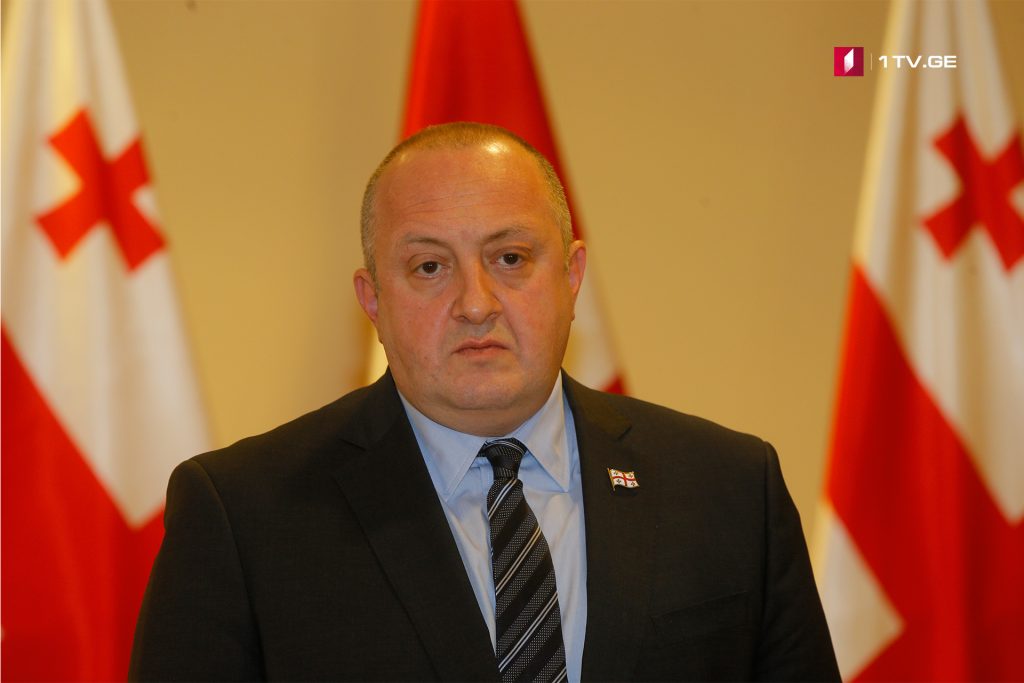
President Saakashvili, whose constitutional term was set to expire in 2013, scheduled presidential elections for October 27, thereby extending his term of office by nearly one year. On October 27, 2013, presidential elections were held, in which the candidate of “Georgian Dream,” Giorgi Margvelashvili, won with 62.1% of the vote. Davit Bakradze from the United National Movement placed second with 21.7%, while Nino Burjanadze received 10.1%, finishing third.

The presidency of Salome Zurabishvili (since 2018) marked a transition from a figure supported by the ruling party to one of the main pro-European critics of the government. As the first female president of Georgia elected by direct vote, she focused her efforts on promoting European integration and defending democratic values, which led to a sharp conflict with “Georgian Dream” and an attempt to impeach her in 2023. Despite limited constitutional powers, Zurabishvili became a symbol of resistance to what she described as “Russian influence,” actively supporting Georgia’s status as a candidate for EU membership on the international stage.
State
Central Authorities
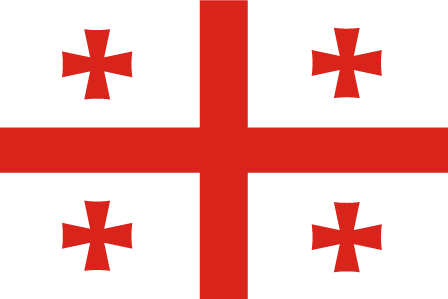
According to the Constitution adopted on August 24, 1995, the highest legislative body – the Parliament – consists of two chambers: the Council of the Republic and the Senate. The Senate includes deputies from Abkhazia, Adjara and other territorial units of Georgia, as well as five senators appointed by the President. At present, the formation of the state apparatus has not been fully completed, and due to political instability a unicameral parliament operates. It is elected for a four-year term on the basis of universal, equal and direct suffrage. 150 deputies are elected under the proportional system and 85 under the majoritarian system. Citizens of the Republic who have reached the age of 18 have the right to vote.
The head of the Republic of Georgia and head of executive power is the President, who is elected by popular vote for a five-year term. The office of President was established in April 1991. A President may serve no more than two consecutive terms. Executive power belongs to the Government. Ministers are appointed by the President with the consent of Parliament. The Government includes the position of State Minister, who performs the functions of Prime Minister.
Local Self-Government
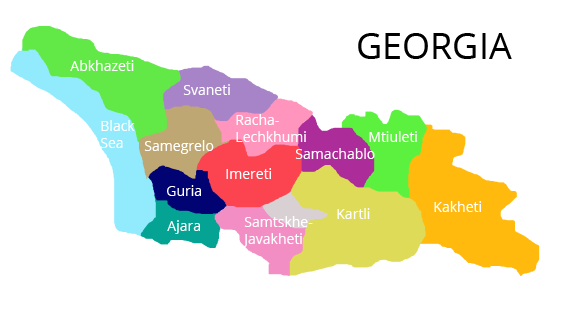
In accordance with the administrative-territorial division adopted in 1995, the Republic of Georgia consists of 9 regions (Samegrelo – Upper Svaneti, Racha-Lechkhumi – Lower Svaneti, Guria, Imereti, Meskheti-Javakheti, Shida Kartli, Kvemo Kartli, Mtskheta-Mtianeti, Kakheti), two cities with regional status (Tbilisi and Poti), and two autonomous republics (Adjara and Abkhazia).
Elections to local authorities – rural, district and city municipalities (sakrebulo) – are conducted under a mixed proportional and majoritarian system.
Judicial System
The system of general courts of first instance includes city courts, district courts, and regional courts. Courts of second instance are the Tbilisi and Kutaisi Courts of Appeal, as well as the Supreme Courts of Abkhazia and the Autonomous Republic of Adjara. The highest judicial authority within the general court system is the Supreme Court of Georgia, which supervises judicial proceedings in these courts, serves as a court of cassation, and hears certain cases of first instance as provided by law. The structure of the Supreme Court includes the Criminal Chamber; the Civil, Business and Bankruptcy Chamber; the Administrative Chamber; the Criminal Chamber; the Supervisory Chamber; and the Plenum. The Chairman and judges of the Supreme Court of Georgia are elected by Parliament upon the nomination of the President.
The High Council of Justice, composed of 12 members (four representatives each from the legislative, executive, and judicial branches), administers the judicial system and conducts competitive selection of judges. Judges of city, district and regional courts are appointed by the President of Georgia for a term of 10 years, while judges of the Supreme Courts of Adjara and Abkhazia are elected by the highest representative bodies of those autonomous entities.
Constitutional review has been exercised since 1996 by the Constitutional Court, which consists of 9 judges (three appointed by the President of Georgia, three elected by Parliament, and three appointed by the Supreme Court). The term of office of the Court is 10 years. Every five years, the Chairman of the Constitutional Court is elected from among its members.
Language
The Georgian language (ქართული ენა – kartuli ena) belongs to the Kartvelian language family, which also includes Megrelian, Svan and Laz (Chan). It is the official language of Georgia and the literary and nationwide language of the Georgian nation.
The Georgian language uses a writing system based on the Georgian alphabet, which follows a phonetic principle. The number of speakers (as of 1993) is about 4 million in Georgia itself and several hundred thousand in other countries, mainly in Russia, the USA and Turkey.
Georgian is the only language among the Iberian-Caucasian languages that has an ancient alphabetic script, although it underwent significant changes in the 11th and 17th centuries. The unique form of its letters is incomparable to any other alphabet in the world. More than 98% of ethnic Georgians consider Georgian their native language. The Abkhaz language belongs to the Abkhaz-Adyghe group of Caucasian languages and has used the Cyrillic script since 1954 (in 1928 a Latin-based script was developed, which in 1938 was replaced by Georgian script).
The Georgian language includes several dialects: Kartlian, Kakhetian, Imeretian, Pshavian, Rachian, Adjarian, Mokhevian, Tush and others.
The modern Georgian alphabet consists of 33 letters, each representing one sound: 5 vowels and 28 consonants.
Features of the Georgian Language
The modern Georgian alphabet has 33 letters — 5 vowels and 28 consonants. It is the only alphabet in the world where one sound corresponds to one letter and vice versa.
There are no strongly marked stresses in Georgian. However, there is a conventional rule. In two-syllable words, stress usually falls on the first syllable; in multi-syllable words — on the third syllable from the end.
There are no grammatical genders in the Georgian language. Georgian writing does not use capital letters.
The Georgian language is very beautiful. Georgian polyphony has been recognized by UNESCO as a masterpiece of cultural heritage. In 1977, two Voyager spacecraft were launched to explore space. On board is a message from humanity to extraterrestrial civilizations. Among the great works included is the Georgian song “Chakrulo”.
Georgian Dialects
There are several Kartvelian languages: standard Georgian – literary (kartuli ena), Svan (lushnu nin), Megrelian (margalur nina), and Laz (lazuri nena). Georgian itself includes several dialects with minor differences: Kartlian, Kakhetian, Imeretian, Gurian, Pshavian, Rachian, Adjarian, Khevsurian, Tush and others.
Interesting Facts About the Georgian Language
The modern Georgian alphabet “Mkhedruli” was created in the 10th century. In the 1860s, Ilia Chavchavadze carried out a reform and reduced the number of letters in the alphabet to 33, removing five archaic and rarely used letters.
The earliest surviving monument of Georgian literature is “The Martyrdom of Shushanik” by Iakob Tsurtaveli, written between 475–484.
1709 — the beginning of book printing in Georgia.
Some common words have been strongly influenced by the nation’s warrior past. For example, “gamarjoba” (hello) originated from a wish for victory. The response “gagimarjos” means “victory to you.” “Good morning” literally means “peaceful morning” (dilamshvidobisa).
Georgian numerals up to 20 are based on the decimal system, and from 20 to 100 on a vigesimal (base-20) system. For example, the number 35 is translated as “twenty and fifteen.”
During the USSR period, the Georgian language had the status of a state language in Georgia.
In ancient Georgian, “juga” means “steel.” That is why Iosif Jughashvili adopted the pseudonym Stalin — essentially a direct translation of his surname into Russian.
The word “gvprtskvnis” (he peels us, he removes our husk) is listed in the Guinness Book of Records for having eight consecutive consonants.
There is a version that the word wine (vine, wine) originated from the Georgian “ghvino” (ღვინო), which in turn derives from the verb “ghvivili” (ღვივილი) — to bloom, to boil, to ferment. The Georgian word “dagvinda” means the completion of the wine fermentation process. It can also describe a person: “dagvinda bichi” means a young man who has matured. This is not surprising, as the tradition of winemaking originated in Georgia in the 6th millennium BC.
In Daniya’s film “Kin-dza-dza!”, the characters speak the fictional Chatlano-Patsak language, which was created based on Georgian. The famous “ku” means “turtle” in Georgian. “Gravitsapa” comes from the Georgian expression “ra vici aba” — “who knows!” “Pepelats” gains a romantic nuance, since “pepela” in Georgian means “butterfly.” “Etsikh” comes from the Georgian “tsikhe” — prison.
Materials used from the website https://v-georgia.com
Religion
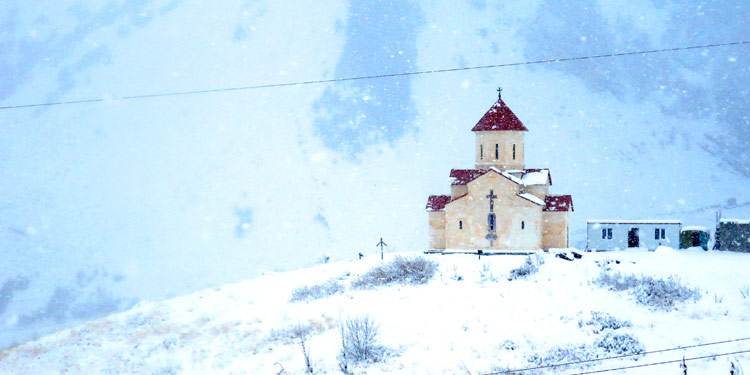
Georgia is officially a secular state in which there is space for the practice and preaching of all major world religions. It is considered that Georgia was the second country in the world (after Armenia) to adopt Christianity as its official state religion — in 326 AD. Approximately 80% of Georgia’s population are Christians, most of whom belong to the Georgian Orthodox Church, which is the most powerful and influential religious institution in the country.
Some Abkhazians and Georgians from the southern and southwestern parts of the country, such as Adjara, are Muslims, as are Azerbaijanis who mainly live in the Kvemo Kartli region, and most Kist people who reside primarily in the Pankisi Gorge.
Assyrians, Armenians, Greeks and Russians have their own Orthodox churches in the country. There is also a small number of Catholics. In addition, Georgia is home to one of the oldest Jewish diasporas in the world, as well as small communities of Doukhobors and Lutherans.
Georgian Orthodox Church
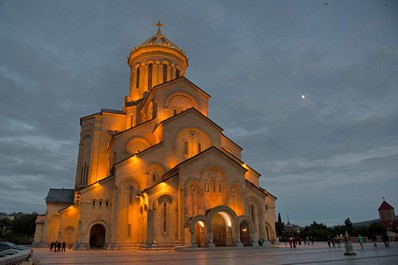
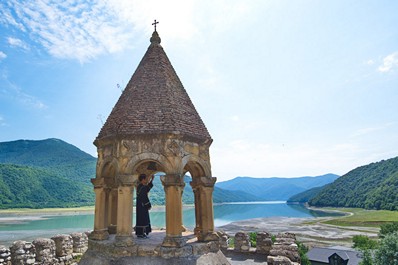
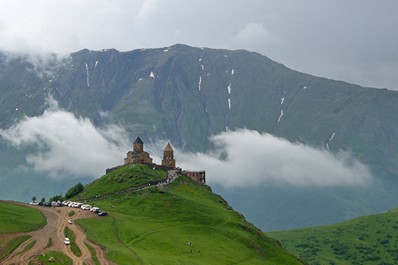
In Orthodox tradition, it is believed that in 44 AD, shortly after the crucifixion of Jesus, the Holy Virgin Mary and the other apostles cast lots to determine which land each of them would travel to in order to preach the Holy Word. According to ancient church tradition, Iberia (the ancient name of Georgia) was the land assigned to the Virgin Mary herself. Today she is venerated by Georgian Christians as the holy patroness of the country.
Georgian church chronicles state that although the Virgin Mary was unable to travel to Iberia and remained in Jerusalem by God’s will, she asked the Apostle Andrew to go there and spread the Gospel in her name. Ancient writings describe how he visited many towns and villages in Georgia, preaching the new religion. In the village of Atsquri (near the modern town of Akhaltsikhe), the prayer of Apostle Andrew brought a dead man back to life. The miracle convinced the first locals to accept Christianity. Apostle Andrew left an image of the Virgin Mary on a wooden board in the village so that the locals could pray before it. The Atsquri Icon of the Mother of God is considered the first of its kind and is currently kept in the National Museum of Georgia in Tbilisi.
In those days, there were two states on the territory of modern Georgia: the eastern state of Kartli (Iberia) and the western state of Egrisi (Colchis). Apostle Andrew preached in both, a fact confirmed not only by Georgian chronicles but also by Greek and Latin church authors.
During the first centuries after conversion, Christians were persecuted by the authorities. However, in 326 AD Christianity became the official state religion thanks to Saint Nino, who was born in the Roman province of Cappadocia. After a vision of the Virgin Mary in a dream blessing her to preach the Christian Gospel in Iberia, she traveled to the Caucasus.
According to traditional sources, Saint Nino erected a large wooden cross on the site of an old pagan shrine outside Mtskheta, the capital of the Iberian Kingdom. Performing miracles, the Cross attracted pilgrims from all over the Caucasus. Today this place is widely known as the Jvari Church. Saint Nino is also credited with converting King Mirian III of Iberia to Christianity, which ultimately led to Christianity becoming the official state religion of the Iberian Kingdom.
By the end of the 4th century, Christianity was firmly established in Georgia. However, in the following centuries Georgia was invaded by Persians, Arabs, Turks and Mongols who practiced other religions. Most of the occupiers attempted to force Georgians to renounce their faith; many people were tortured and killed. Despite the often tragic history of the Georgian Church, the faith of the local population endured, and Christianity today is perhaps stronger than ever before.
Georgia has a vast number of churches and monasteries, many of which also served as educational centers in their time. Since the 9th century, the Georgian Orthodox Church has been led by the Catholicos-Patriarch. In the 12th century, during the period considered the Golden Age of the country, King David IV (better known as David the Builder) ordered the construction of the Gelati Monastery and Academy near Kutaisi. Within a short time, the Academy became one of the greatest theological and scientific schools of the Orthodox world.
From the beginning of the 19th century, Georgia became part of the Russian Empire. Subsequently, an Exarchate was established, through which the Georgian Orthodox Church was integrated into the Russian Orthodox Church and lost its autocephaly. In 1917, after the revolution in Russia, Georgian authorities were able to proclaim the country’s independence, and the Georgian Church restored its sovereignty as well. During the Soviet era, atheism, although never officially declared a component of state ideology, was actively supported by the Party. Most churches and mosques did not function, and many clergy were arrested. The revival of Christianity came with Perestroika in the USSR.
Since 1977, the leading position has been held by Archbishop of Mtskheta and Tbilisi Ilia II. Thousands of tourists make pilgrimages to Georgia to see the relics preserved there and to visit the many holy sites throughout the country.
Judaism
Georgia is home to one of the oldest Jewish diasporas in the world. According to the “Georgian Chronicles,” the Jewish people arrived in Georgia after the conquest of Jerusalem in 586 BC by the Babylonian king Nebuchadnezzar II and the subsequent Babylonian exile. The Jewish community preserved its faith and culture here for centuries. Although the Jewish population in Georgia declined sharply in the second half of the 20th century, when emigration from the Soviet Union became possible, most of those who chose to remain still live in the capital, Tbilisi. There are also small Jewish communities in Kutaisi, Gori, Surami, Oni, Akhaltsikhe and Batumi. In all these cities, you can find synagogues, many of which are still functioning today.
Armenian Apostolic Church
The Armenian Church has existed in Georgia for more than 1,500 years — since the 5th century AD. In the 11th century, the Armenian Church was granted the status of a diocese in Georgia, with its administrative center at the Surb Gevorg Church in Tbilisi. More than 600 religious and cultural sites, including seminaries and monasteries, were historically associated with the Armenian Church in Georgia, but unfortunately many of them were destroyed either due to natural disasters or vandalism. The majority of the Armenian diaspora living in Georgia today are followers of the Armenian Apostolic Church. According to the Church itself, there are currently 32 active Armenian Apostolic churches in Georgia: 2 in Tbilisi and the rest mainly located in Armenian towns and villages, primarily in the Samtskhe-Javakheti region (Akhalkalaki, Ninotsminda, Tsalka), as well as some in Kvemo Kartli.
Russian Orthodox Church
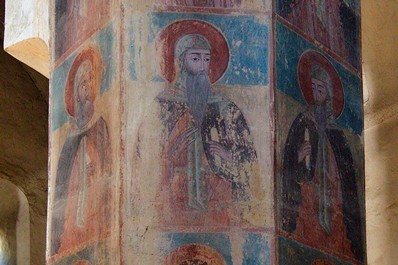
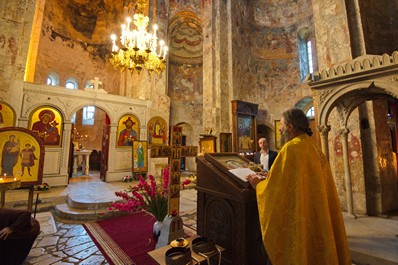
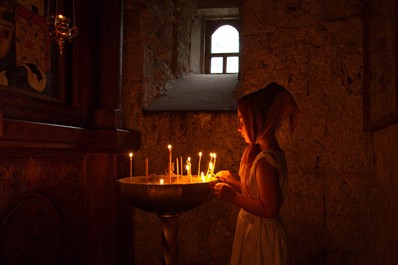
Russian Orthodoxy officially appeared in Georgia simultaneously with Georgia’s incorporation into the Russian Empire in 1801. From 1811 to 1917, the Georgian Church effectively existed as an Exarchate of the Russian Church, which meant that the latter held a dominant status. The Georgian Patriarchate was abolished in violation of church rules.
Followers of Russian Orthodoxy in Georgia are mostly voluntary civilian migrants from Russia and other former Soviet republics.
During the Soviet period, Russian churches suffered the same fate as many religious buildings of other denominations: some were destroyed, while others were converted into public and secular institutions, museums, libraries, warehouses, and so on.
Today, three Russian Orthodox churches operate in Tbilisi, where services are partially conducted in Russian. One of them is the Alexander Nevsky Church, built in 1864 with donations from parishioners and funds allocated by the Holy Synod of Russia. Notably, it houses relics of Saint Mary Magdalene, Saint Nino, and Saint Nicholas. Another church, built in Tbilisi in 1911–1913 by architect Johann Ditzmann, is dedicated to Saint Prince of Tver, the heavenly patron of Grand Duke Mikhail Alexandrovich Romanov. The building is constructed in the best traditions of Russian ecclesiastical architecture, and its grounds offer a breathtaking panoramic view of Tbilisi.
Islam
Islam appeared in Georgia in the 7th century, when an army sent to Tbilisi by the third Caliph of Islam, Uthman, invaded Eastern Georgia and established Muslim rule. Today, Muslims make up about 10 percent of Georgia’s population. One of the two main Muslim groups in Georgia are Sunni Hanafis. They are concentrated in the Autonomous Republic of Adjara, which borders Turkey. This part of Georgia was under the rule of the Ottoman Empire for a certain period in its history, which led to the Islamization of part of the local population.
The Shia Ithna Ashariya are mainly ethnic Azerbaijani Muslims living along the borders with Azerbaijan and Armenia. The Pankisi Gorge is home to the ethnic Kist community, who also practice Islam.
The oldest and most unique mosque in Georgia is the Juma Mosque in Tbilisi. This beautiful 18th-century architectural monument is located in Old Tbilisi on a hill between Narikala Fortress and the sulfur baths. Another major mosque of the country is located in Batumi. There are also small mosques in mountainous Adjara.
Catholicism
The Georgian Catholic community has existed for centuries but has never been large. Today it numbers around 80,000 people (approximately 2% of the country’s population). The history of the Catholic Church in Georgia began in the 13th century, two hundred years after the schism between the Eastern and Western branches of Christianity.
The division between Western and Eastern Christianity was not felt as strongly in Georgia, and Georgian kings respectfully received representatives of the Pope. The first missionaries to arrive in Georgia were members of the Franciscan Order, soon followed by Dominicans. A formal Latin episcopal see functioned in Georgia from the 13th century until the early 16th century.
Most Catholic churches in the country were either destroyed during the Soviet period or transferred under the administration of the Georgian Orthodox Church. Today only a few Catholic churches are open in Georgia, including the Cathedral of the Assumption of the Virgin and the Church of Saints Peter and Paul in Tbilisi, and the Church of the Holy Spirit in Batumi. The magnificent Annunciation Church in Kutaisi is currently under the jurisdiction of the Georgian Orthodox Church.
Among Georgian Catholics are prominent cultural and educational figures such as Zakaria Paliashvili, who composed the music of Georgia’s national anthem and founded the national school of composition; Petre Melikishvili, founder of Tbilisi State University; Simon Kaukhchishvili, founder of Georgian classical philology; the businessman and philanthropist Zubalashvili brothers; and one of the greatest writers, scholars and political figures in Georgia’s history — Sulkhan-Saba Orbeliani.
Doukhobors
The Doukhobors are both a religious confession and an ethnic group. All Doukhobors originate from Russia and today mainly live in Russia, the Caucasus and Canada. The word “Doukhobor” means “spirit fighter.” They call themselves “Orthodox Christians without intermediaries” and do not accept church institutions. Doukhobors believe in reincarnation and the Holy Spirit, reject the cross and use chants and spiritual incantations. For this reason, the Russian Orthodox Church historically regarded them as sectarians. In 1839, Russian Emperor Nicholas I gave the Doukhobors an ultimatum: either accept Orthodoxy or permanently relocate to the newly conquered Caucasus region. Between 1839 and 1845, about 5,000 Doukhobors settled in two Georgian regions — Javakheti and Dmanisi — and founded ten villages: Vladimirovka, Tambovka, Rodionovka, Bogdanovka, Spasovka, Orlovka, Gorelovka, Efremovka, Kalmykovo and Troitskoye.
After the mass resettlement of Doukhobors from Georgia in the 1990s, only one village — Gorelovka — remained on the map. Today there are about 50 households with around 135 residents. It is a unique place in Georgia where Russian remains the native language of local inhabitants, and people still wear traditional national clothing passed down through generations. The Doukhobors are known for preserving the traditions of Russian folk singing.
Lutheranism
Lutherans from Germany were the first Protestants to move to Georgia. German expatriates of the early 19th century were promised substantial privileges in their new homeland: freedom of religion, exemption from military service, financial assistance, tax exemption for 10 years, and more. In September 1817, the first group of immigrants (31 Swabian German families from Württemberg) arrived in Tbilisi. Within the next two years they founded six major German settlements in Georgia: Marienfeld, Neu-Tiflis, Alexanderdorf, Petersdorf, Elisabethtal and Katharinenfeld. Elements of traditional German architecture in these historic districts continue to impress travelers to this day.
In 1897, the Lutheran Church of St. Peter and Paul opened in Tbilisi. A German gymnasium operated at the church and was popular even during Soviet times. For example, the son of Lavrentiy Beria studied there. The church stood on the left bank of the capital’s main river, the Mtkvari. From the early 1930s, Lutherans were subjected to repression, and the church gradually fell into ruin.
The revival of Lutheranism in Georgia is associated with the work of Gert Hummel, a professor at the Lutheran University in Saarbrücken, Germany. He moved to Georgia in the late 1980s and began missionary activities. Hummel sold his home in Germany and in 1995 began building a new Lutheran church in Georgia. In 1997, exactly 100 years after the consecration of the original Lutheran Church of St. Peter and Paul, the new church “Reconciliation” opened in Tbilisi. In Batumi there is the Protestant Church of the Holy Trinity. Small communities also exist in Rustavi (home to the Rustavi Evangelical-Lutheran Church) and in the city of Gori.
Material from https://www.advantour.com/
CULTURE
Georgia is a country of ancient and distinctive culture.
The culture of Georgia is primarily formed by the main Kartlian ethnic group of Georgians, as well as by the cultures of Kakhetians, Imeretians, Mingrelians, Gurians, Javakhetians, Muslim Adjarians, Laz people, and Ingiloys. It also includes the sub-ethnic cultures of Georgia’s small mountain peoples: Mokhevians, Khevsurs, Pshavs, Tushes, Mtiuls, Gudamakarians, Torians, Rachians, Lechkhumians, Svans, and Meskhetians. Among these groups, the Svans stand out most for their strong cultural identity, as do the Khevsurs.
EDUCATION SYSTEM
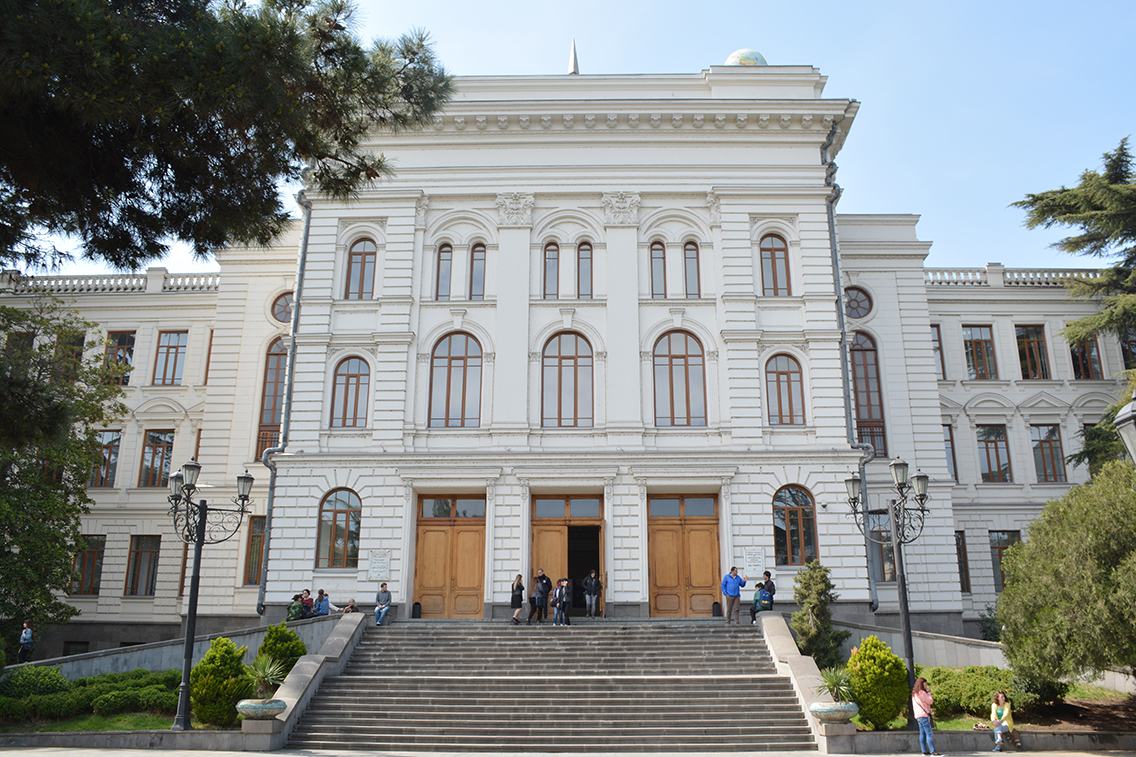
Education in Georgia has long-standing traditions. Medieval monasteries and academies were important centers of enlightenment and preserved national heritage even during periods of foreign domination.
After gaining independence, Georgia faced serious challenges in financing its education system. Preschool education suffered the most during the crisis. In many areas, especially rural ones, local budgets are unable to maintain kindergartens, resulting in increased fees for children’s attendance. To secure funds for teachers’ salaries and maintenance staff, leasing parts of kindergarten buildings has become a common practice.
Most children aged 6 to 17 attend school, and in three-quarters of schools instruction is conducted in the Georgian language. Russian-language education is provided in more than 200 schools across Georgia (excluding Abkhazia and South Ossetia), where Russian curricula, textbooks, and teaching materials are used. In Abkhazia, however, the number of schools offering education in Georgian has decreased. Since 1995, children entering first grade in schools of the Gali district of Abkhazia have been taught only in Russian. As a result, instruction in grades 1–3 has mainly been conducted in Russian, and Georgian-language education for senior students has remained in only nine schools in the district.
A new education law was adopted in 1997. Primary education lasts six years, from ages 6 to 12. After that, students move to a two-year basic school or vocational-technical school (ages 12–14). Secondary education lasts three years and is divided into general, vocational-technical, and specialized tracks (ages 14–17). A secondary school diploma allows graduates to compete for admission to all higher education institutions in the country.
The system of higher education institutions in Georgia includes universities, academies, and institutes. The country has 26 state higher education institutions (including 8 universities) and 209 private higher education institutions. Instruction is mainly conducted in Georgian, although some institutions offer programs in Abkhaz, Azerbaijani, Armenian, Russian, English, and German. Education in public universities can be either free or fee-based. Students are supported by a system of scholarships and grants. After completing a four-year program, graduates receive a Bachelor’s degree; after six years, a Master’s degree. After completing a Master’s program, students may enter postgraduate studies, defend a dissertation, and obtain a doctoral degree.
The oldest educational institution in the country is Ivane Javakhishvili Tbilisi State University (founded in 1918), which has five regional branches, four research institutes, 20 faculties, 140 departments, 57 research and problem laboratories, nine national research centers, seven museums, an information center, and a scientific library holding approximately 3.5 million items. The university enrolls more than 30,000 students. Other major higher education institutions include the Georgian Technical University, Tbilisi State Pedagogical University, Tbilisi State Medical University, Tbilisi Academy of Economics and Law, Tbilisi Institute of Asia and Africa, Tbilisi State Academy of Arts, Shota Rustaveli State Institute of Theatre and Film, and the Tbilisi Conservatoire (founded in 1917). State universities employ highly qualified professors and lecturers. New institutions based on international partnerships have also been established, such as the European School of Management (sponsored by the Shevardnadze Foundation) and the Institute of Public Administration (a joint educational institution with the U.S. National Academy of Public Administration and Political Science, operating under American programs and textbooks and inviting foreign lecturers).
LITERATURE AND ART
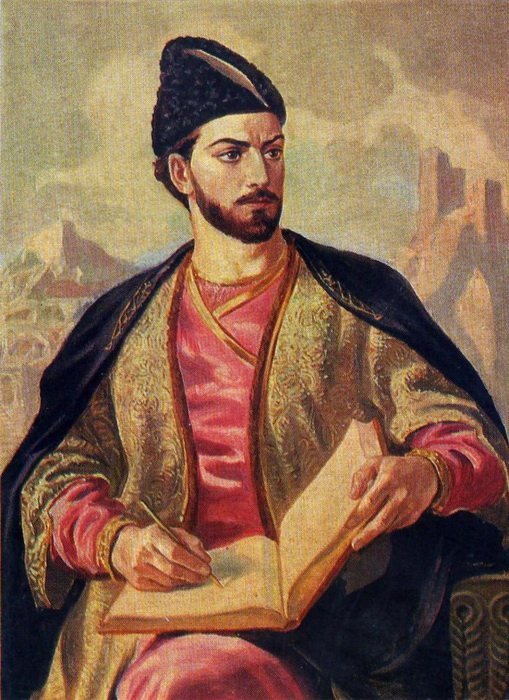
The earliest surviving monuments of Georgian literature date back to the 5th century AD. Many outstanding figures have contributed to Georgia’s literary heritage. Among them are Shota Rustaveli (12th century), author of the epic poem The Knight in the Panther’s Skin; Sulkhan-Saba Orbeliani, author of the first explanatory dictionary of the Georgian language (1716); Ilia Chavchavadze, Alexander Kazbegi, Akaki Tsereteli, Galaktion Tabidze, Konstantine Gamsakhurdia, Niko Lordkipanidze, Mikheil Javakhishvili, and Anna Kalandadze (20th century). Brilliant works of prose and poetry such as the poem Merani by Nikoloz Baratashvili, the forty epic works of Vazha-Pshavela (Guest and Host, The Wedding of the Bold Man, etc.), Gamsakhurdia’s novel The Right Hand of the Grand Master, and Tabidze’s poems Moon of Mtatsminda and The Wind Blows are widely recognized masterpieces. Many works by Georgian authors have been translated into Russian and other languages.
THEATRE
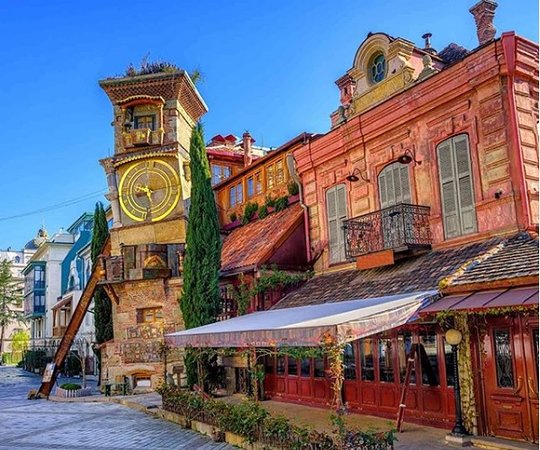
Georgian dramaturgy dates back to the mid-19th century. Its founder is considered to be the writer, translator, and theatre figure Giorgi Eristavi (1811–1864). There are more than 30 theatres in Georgia. Among the most popular are the Zakaria Paliashvili Academic Theatre of Opera and Ballet, the Shota Rustaveli State Academic Drama Theatre, the Kote Marjanishvili State Academic Drama Theatre, the A.S. Griboyedov State Russian Drama Theatre (which celebrated its 150th anniversary), the Vaso Abashidze State Musical Theatre, the Petros Adamian State Armenian Drama Theatre, the Tbilisi State Marionette Theatre, and the G. Mikeladze State Puppet Theatre.
CINEMA
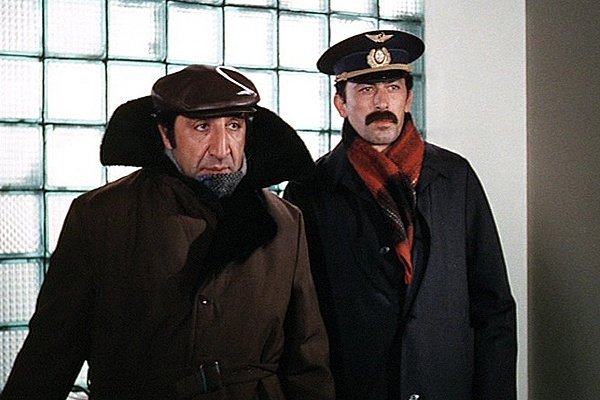
Georgian cinema, which emerged as a phenomenon during the Soviet era, is a vivid and distinctive cultural expression. Most Georgian films were produced at the “Georgia-Film” studio. Beyond their inherent national flavor, Georgian films were known for their recognizable style — characterized by subtle humor, metaphorical depth, and deep sympathy for human characters. During the Soviet period, Georgian filmmakers managed to avoid rigid socialist realism and created original, independent works that enjoyed great popularity throughout the Soviet Union.
In 2001, the state established the Georgian National Film Center, which since 2003 has partially financed several films per year that qualify as “national films” after competitive selection. In 2011, approximately 70% of the Film Center’s total budget of 2.4 million USD was allocated to film production. In addition to production, the Center is engaged in distribution and international promotion of Georgian cinema.
Among the most notable films of recent years are Street Days by Levan Koguashvili and The Other Bank by Giorgi Ovashvili. According to film critic Andrei Plakhov, these films “genetically absorbed the high artistic standards of Georgian cinema, yet their worldview is not that of the 1960s generation but contemporary; the realities on screen are harsher, and the poetics and stylistics are different as well.” Levan Zakareishvili’s film Tbilisi-Tbilisi won several awards, including the Nika Film Award.
The lack of stable domestic funding has led many Georgian directors and actors to move abroad. Director Nana Jorjadze works with German producers. Otar Iosseliani and Teimuraz Babluani settled in Paris. His son, director Gela Babluani, is known for the noir film 13. A joint Russian-Georgian project includes Love with an Accent by Rezo Gigineishvili.
Films such as Invasion by Dito Tsintsadze and Beginning by Dea Kulumbegashvili have received awards at international festivals.
PAINTING.
Georgia is renowned for its 7th–13th century wall paintings preserved in the Gelati Monastery, Ateni Sioni, and churches in Betania, Kintsvisi, and other locations. Georgian painters who gained wide recognition include Niko Pirosmanishvili (Pirosmani), Gigo Gabashvili, David Kakabadze, Lado Gudiashvili, Korneli Sanadze, Elena Akhvlediani, Sergey Kobuladze, Simon Virsaladze, and Ekaterine Bagdavadze.
Georgian art is distinguished by its refinement, combining local and European styles. Artists such as Lado Gudiashvili, David Kakabadze, and Elena Akhvlediani worked in Paris during the 1920s. Georgian sculptors of worldwide fame include Elguja Amashukeli, Irakli Ochiauri, and Zurab Tsereteli.
MUSIC.
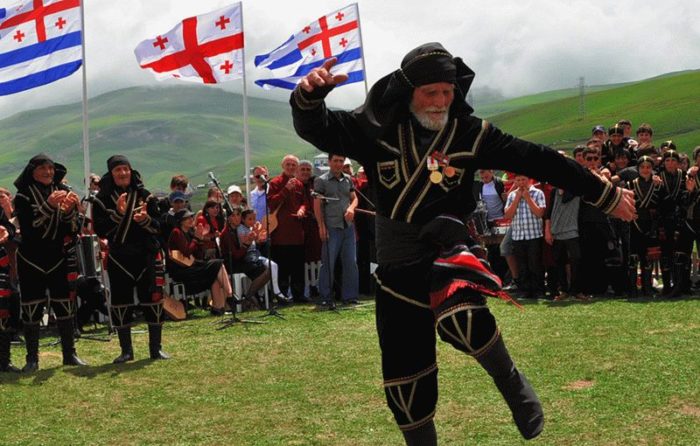
Georgian culture has influenced the music, dance, literature, national costumes, and many other aspects of neighboring countries. Georgian art is distinguished by its vibrant character and beauty. Among the most famous Georgian dances are the wedding dance “Kartuli,” “Acharuli,” “Kinto,” “Rachuli,” “Mtiuluri,” “Kazbeguri,” and many others that originated in various regions of Georgia.
The roots of Georgian folk music go back several millennia.
Georgian musical folklore includes a variety of regional dialect traditions: Tush, Khevsur, Mtiul, Kartlian, Kakhetian, Rachian, Pshavian, Mokhevian, Lechkhumian, Svan, Mingrelian, Imeretian, Gurian, Adjarian, and Laz.
A distinctive feature of Georgian folk music is polyphony: two-, three-, and four-part singing.
There are also monophonic songs performed without accompaniment: orovela (plowing, threshing, winnowing songs), urmuli (cart-driver songs), nana (lullabies), tirili and datireba (lamentations).
Two-part songs include labor, ritual, domestic, and dance songs. They are performed by one or two soloists alternately against a choral drone bass or basso ostinato.
Three-part singing forms the foundation of traditional Georgian music: over a bass line, two upper voices develop the melody in various combinations. In Western Georgia, Svan songs stand out for their strict and powerful sound. These songs are characterized by frequent dissonant combinations and the simultaneous movement of three voices in primary triads. Folk polyphony in all its richness is especially evident in Gurian and Adjarian songs. They feature krimanchuli — the name given to a special high upper voice that requires the soloist to sing in an unusually high register (for a male voice) and to perform complex throat-based ornamentations.
Georgian art, from the 4th–5th centuries through the turn of the 18th–19th centuries, followed a long and complex path of development closely connected with the evolution of the Georgian people and statehood. Like all living art, Georgian art was closely linked with the artistic traditions of neighboring regions of Western Asia and the Mediterranean basin. These interactions enriched Georgian art, while it in turn made a significant contribution to the development of medieval world art. On the one hand, there is a clear genetic connection with the pre-feudal era; on the other hand, one can observe an expansion of artistic range, deepening, and enrichment of content. It was during the Middle Ages that the distinctive national features of Georgian art manifested themselves most vividly.
MUSEUMS, LIBRARIES AND SCIENTIFIC INSTITUTIONS.
There are 110 museums operating in Georgia, more than 20 of them located in Tbilisi alone. The Simon Janashia Museum of Georgia, transformed in 1919 from the Caucasus Museum, is the largest treasury of Georgian cultural heritage. It presents items of material culture beginning from the Lower Paleolithic period, demonstrating the development of civilization on the territory of Georgia and the Caucasus as a whole; examples of artistic crafts from various regions of Georgia; and a collection of coins from Georgia as well as from countries of the Near East. The museum also includes geological, biological, and zoological departments, as well as a department dedicated to the modern and contemporary history of Georgia. The Shalva Amiranashvili State Museum of Fine Arts of Georgia houses a rich collection of ancient Georgian, Russian, Soviet, Western European, and Eastern art. Other successfully operating museums include the National Gallery, the State Museum of Contemporary Fine Arts, the State Museum of Folk and Applied Arts, the Museum of Georgian Literature, the Ioseb Grishashvili Tbilisi History Museum, the State Museum of Music, Theatre and Cinema, and the Niko Pirosmani State House-Museum. The Niko Berdzenishvili Kutaisi Historical and Ethnographic Museum contains traditional residential buildings collected from various regions of Georgia.
The largest libraries in Georgia are the National Library, founded in 1846, with a collection of more than 7 million items; the library of Tbilisi State University; the Central Scientific Library of the Georgian Academy of Sciences; as well as the central libraries of Abkhazia and Adjara.
The leading scientific institution of the country is the Georgian Academy of Sciences, established in 1941 as a branch separated from the Academy of Sciences of the USSR. The Academy includes departments of mathematics and physics; earth sciences; applied mechanics and mechanical engineering; chemistry and chemical technologies; biology; physiology and experimental medicine; agricultural sciences; social sciences; language and literature, with 53 institutes and several research centers.
Georgia has produced a number of world-renowned scholars. Nikoloz Berdzenishvili (1894–1965) published the first textbook on the history of Georgia; Mose Janashvili (1855–1934) authored numerous scientific and popular works on history, ethnography, and linguistics, many devoted to Russian-Georgian relations; Nikoloz Muskhelishvili (1891–1976), a mechanic and founder of the Georgian school of mathematics, served as President of the Georgian Academy of Sciences from 1941 to 1972; Alexander Tsagareli (1844–1929), the first Georgian professor-philologist and member of scientific societies in Russia, Norway, Italy, and France, was one of the founders of the State University of Georgia; Ilia Vekua (1907–1977), mathematician and mechanic, served as President of the Georgian Academy of Sciences from 1972 to 1977.
ARCHITECTURE
Monumental Georgian architecture developed in the Middle Ages in connection with the formation of statehood, the spread of Christianity, and the construction of churches. In the 5th–6th centuries, the basilica was the predominant type of Georgian church architecture. Several early Georgian basilicas are well known: Anchiskhati, Tsqarostavi, and Urbnis Basilica. The most famous is Bolnisi Sioni, whose construction began in 478 and was completed in 493; it is the oldest and best-preserved basilica. The three naves were covered with vaulted ceilings and unified under a common gabled roof. Galleries with beautiful roofing were arranged on the northern and southern sides. On the eastern side, a closed baptistery was constructed.
The founders of Georgian conducting art were People's Artist of the Georgian SSR Z. P. Paliashvili and Honored Art Worker of the Georgian SSR E. S. Mikeladze.
Customs and Traditions
Georgian traditions are rich and distinctive, having been shaped over many centuries. They are passed down from generation to generation, carefully preserved and observed with special reverence. Among the most widespread traditions of the Georgian people are winemaking, hospitality, the traditional feast, and, of course, wedding customs.
Traditions of Georgian Winemaking
For many centuries, winemaking has been not only the foundation of Georgia’s economic prosperity but also an essential part of its spiritual culture. For a Georgian, wine is not merely a drink. The attitude toward it is almost religious. Wine strengthens the spirit of the people and unites guests at traditional Caucasian feasts. The grapevine is celebrated in Georgian legends, myths, and songs. In Georgia, wine is a national treasure that attracts tourists from all over the world.
Historically, Georgia has been a land where the cult of winemaking flourished. Today, no one can say exactly when and from where the first grapevine appeared on this land, but the favorable climate has long contributed to the growth of amber grape clusters here. Imprints of ancient grape leaves discovered in Georgia, as well as clay vessels found in old burial sites containing remnants of grape seeds, leave no doubt that Georgia was one of the cradles of winemaking in ancient times.
This is also evidenced by winemaking equipment discovered by archaeologists in the country — stone presses, grape crushers, and various wine vessels made of clay and metal dating back to the 3rd–2nd millennia BC. The deep roots of Georgian winemaking are further confirmed by images of grapevines found on large conical wine-storage vessels buried in the ground — the famous “qvevri” — discovered in settlements that, according to archaeologists, are approximately 8,000 years old.
Traditions of Hospitality
“A guest is a messenger of God,” says a Georgian proverb. Over the centuries, the Georgian people have developed a strong culture of hospitality. From generation to generation, love and boundless respect for the guest, devotion to the duties of the host, and the tradition of the feast have been passed down. As a result, Georgian culture has formed a high standard of hospitality. For a guest, nothing is spared. In past centuries, some regions of Georgia even had special guest rooms or separate guest houses whose doors were always open, allowing travelers to enter at any time, eat, and spend the night.
According to Georgian folk poetry, hospitality is valued more highly than bravery, courage, or skill in handling weapons. Georgian folklore idealizes the generous and welcoming host and condemns stinginess. At the same time, great importance is attached to the moral conduct of the guest. A guest must be reserved, modest, and courteous. According to Georgian (and broader Caucasian) tradition, a guest would remove his weapon at the entrance and hand it over to the host or the eldest member of the family. Through this noble act, the guest demonstrated trust, loyalty, and respect toward the host. It symbolized entering the household with good intentions — in peace and friendship.
Traditional Feast
An essential attribute of Georgian — and more broadly Caucasian — hospitality is the traditional feast, which implies exemplary order, good manners, and strict observance of proper etiquette. The feast is guided by the leader of the Georgian table — the tamada (toastmaster). The wisdom and eloquence of the tamada, as well as the toasts he delivers, determine the spirit of the celebration. In short, the tamada is both the master of ceremonies and the adornment of the table. According to ancient custom, the host who invites guests into his home must either assume the duties of the tamada himself or choose one from among respected and достойных people. Conducting a feast is a complex and responsible task: the tamada must constantly control the course of the celebration, skillfully regulate order at the table, monitor the sequence and content of the toasts, avoid excessive verbosity, and intersperse speeches with humor, well-timed anecdotes, or cheerful stories.
The tamada must give attention to everyone and ensure that no one is offended, even unintentionally. The greatest art of the tamada is preventing guests from becoming intoxicated too quickly and maintaining the unity of the feast. At the same time, excessive strictness in limiting wine consumption may offend a guest. In short, it is a delicate art refined over many years.
A Georgian feast is always accompanied by toasts. Toasts express the best wishes of hosts and guests alike. They bless the family, wish one another prosperity, the strength to overcome life’s challenges, health and happiness, courage against enemies, and they condemn evil while praising kindness and sincerity.
There are certain rules in the order of toasts. The first toasts are obligatory: a welcoming toast, congratulations on the gathering, wishes for general well-being, followed by a toast dedicated to the occasion being celebrated. Among the most important are toasts to the health of parents and to peace within the family. After the principal toasts, improvisation begins. One of the last toasts is raised in honor of the tamada, thanking him for conducting the feast so masterfully. The final toast is often dedicated to the Saints who protect each participant of the feast and to the hosts, expressing gratitude for their hospitality and wishing them happiness and good health.
And of course, a Georgian feast is always accompanied by music — lively dances are performed and beautiful polyphonic songs are sung.
Georgian Wedding Traditions
A traditional Georgian wedding is a beautiful, spectacular, and lavish celebration that carefully preserves the unique customs of the Georgian people. The first rule of a Georgian wedding is the abundance of invited guests. Sometimes the number reaches several hundred. Declining a wedding invitation is considered impossible, as it may deeply offend the hosting family and can even lead to long-term tensions between families.
The creation of a family in Georgia traditionally consists of three stages: machankloba — matchmaking, nishnoba — engagement, and kortsili — the wedding itself. Although today parents often no longer choose a bride or groom for their children as they once did, the role of the family in marriage remains very important. A marriage must be approved by relatives. Both families approach this step with great responsibility, trying to learn as much as possible about the future in-laws before agreeing to matchmaking. Once the formalities are completed, the engagement ceremony follows.
According to a beautiful Georgian custom, when the bride enters her future home for the first time, the groom climbs onto the roof and releases a white bird into the sky. The couple is then offered a wedding cup of wine. The groom drinks first, places the wedding ring inside the cup, and passes it to the bride. After taking a sip, she retrieves the ring, and the groom officially presents it to her with words of love and devotion.
After this, the bride symbolically “inspects” the groom’s home, where she will become the hostess. Accompanied by witnesses and guests, the bride and groom break a decorative plate “for good luck” at the entrance. To ensure prosperity and fertility, grains are scattered in the corners of the house, and the couple is given wooden ornaments called “chiragdani,” symbolizing the Tree of Life. During the ritual walk through the house, the bride touches a cooking pot — a symbol of the household hearth — and walks three times around a pot filled with oil or wheat.
At a Georgian wedding, guests do not shout “bitter” (as is common in some Slavic traditions). Yet the celebration is lively and joyful. The tamada (toastmaster) ensures that no guest is bored and invites everyone to raise a toast. The first toast is dedicated to the bride and groom, wishing that their home be filled with peace, prosperity, and the laughter of children.
One of the most romantic and beautiful Georgian (and Caucasian in general) wedding rituals is the “bride kidnapping.” In reality, this is symbolic and takes place with the consent of the bride and her parents. It is often practiced to reduce the expenses associated with organizing a large traditional wedding. Not every family can afford a grand celebration in accordance with ancestral customs. After the “kidnapping,” a modest feast for close relatives may suffice. The marriage is then considered valid, and the full wedding celebration can be held years later when circumstances allow.
The groom’s family traditionally bears the main expenses of organizing the wedding. The bride’s financial status is of little importance. Her greatest virtues are modesty, purity, piety, domestic skills, and a calm character. In Georgia, girls are traditionally raised with values of chastity and dignity. The man is regarded as the head of the family, its support and physical protector, while the woman is its spiritual strength, guardian of the home, and keeper of ethical traditions.
WEATHER IN GEORGIA
On our continent, the countries that are protected by mountain ranges from the central continental mass are especially fortunate. This is true for any continent, but particularly for ours, as it is the largest and the coldest. Georgia has been fortunate with the Caucasus Mountains. Harsh continental cyclones, capable of reaching as far as Vietnam, do not make it to Georgia. At worst, they break through from the Black Sea or the Caspian side, but by then they have significantly weakened.
As a result, the so-called January zero isotherm runs along the Caucasus. Simply put, south of this line the average January temperature at sea level does not drop below zero. Frost and snow are rare there — again, at sea level.
The practical consequence: lowland Western Georgia hardly sees snow in winter, and temperatures typically range between +2°C and +4°C. Central Georgia lies at about 500 meters above sea level, so light frosts may occur. Eastern Georgia is somewhat colder. The foothills are colder still and receive more snow. In the mountainous regions of Svaneti and Khevsureti, winter is very real, with steady snowfall. Above 3,000–4,000 meters, snow remains year-round — glaciers are found there.
In 2011, snow in Svaneti fell only on February 27, while in Tbilisi the first snowfall occurred on February 19.
Ski resorts generally operate from December through April. In 2010, sub-zero temperatures in Gudauri began in early December.
During winter, some highland settlements become deserted. For example, people live at the Zekari Pass only during the summer months. It is said that in Samtskhe-Javakheti winter can be “worse than Siberia,” with temperatures dropping to –40°C. Yet just beyond the mountain ridge in Adjara, palm trees grow. In early December 2010, Batumi recorded +23°C, cooling only to +15°C by the end of the first week of December.
Some mountain passes close in winter, typically from October to April.
The Cross Pass closes only occasionally.
The Datvisjvari Pass in Khevsureti — from November to May.
Tskhratskaro (Trialeti Range, 2454 m) — similarly.
Zekari (Meskheti Range, 2162 m) — from October to June.
Goderdzi (Khulo–Adigeni road) — from October to May.
Mamison Pass — from October to May (though currently closed due to the border).
This means that in spring travel is not possible everywhere in Georgia. Spring is generally not considered the best season to visit. March, in particular, is not especially favored.
July and August can be quite hot. In July 2010, Tbilisi experienced prolonged temperatures of +40°C. During this time, many residents leave for country houses or head to the mountains. Western Georgia can feel especially oppressive due to humidity.
September and October are considered the ideal season. The heat subsides, vegetables and grapes ripen, and in Samegrelo one can catch the unique moment when the Black Sea is still warm while skiing is already possible in the mountains.
Even in summer, Georgia varies greatly. The western regions — Samegrelo, Imereti, Adjara, and Guria — are characterized by heat, humidity, forests, and abundant greenery. The Surami Range divides the country into two “color zones”: green and yellowish. Adjara is the most humid part of the west.
The central part of the country is dry and yellowish, with fewer forests. Kakheti is similar but harsher, with dry winds sometimes blowing from Azerbaijan. Kakheti even has steppe-like areas and near-desert landscapes with snakes, turtles, and lizards — for example, the Shiraki Steppe.
The southern region (Javakheti) differs slightly, in some places resembling Greece.
The climate allows Georgia to grow pomegranates, lemons, and oranges. Bamboo and even bananas grow here, although bananas do not fully ripen.
Regions of Georgia
Modern Georgia is divided into 71 districts (in practice, 63):
Abasha, Adigeni, Ambrolauri, Aspindza, Akhalgori, Akhalkalaki, Akhaltsikhe, Akhmeta, Baghdati, Bolnisi, Borjomi, Vani, Gardabani, Gori, Gurjaani, Dedoplistskaro, Dmanisi, Dusheti, Zestafoni, Zugdidi, Kazbegi, Kareli, Kaspi, Kvareli, Keda, Kobuleti, Lagodekhi, Lanchkhuti, Lentekhi, Marneuli, Martvili, Mestia, Mtskheta, Ninotsminda, Ozurgeti, Oni, Sagarejo, Samtredia, Sachkhere, Senaki, Signagi, Telavi, Terjola, Tetritskaro, Tianeti, Tkibuli, Kharagauli, Khashuri, Khelvachauri, Khobi, Khoni, Khulo, Tsageri, Tsalka, Tsalenjikha, Tskaltubo, Chiatura, Chokhatauri, Chkhorotsku, Shuakhevi.
+ the cities of Batumi, Kutaisi, Rustavi, and Poti, which are now also considered municipalities.
This administrative division was established in 1930 and has not fundamentally changed since then, although the number of districts gradually increased. During the period of independence, districts were officially renamed municipalities, although the term “district” (raioni) is still commonly used, and for simplicity it will be used here as well.
In the 1990s, another administrative level was introduced — the “region” (mkhare). Formally, there are 11 regions. Among them, Abkhazia and Adjara are considered autonomous republics. South Ossetia was not granted a separate status and was included within the Shida Kartli region, while the Akhalgori district was incorporated into the Mtskheta–Mtianeti region. The head of a region is called the “State Representative of the President of Georgia” and is appointed by the President.
In practice, a district consists of several dozen villages and one administrative center. A district usually contains no more than one city, so the number of cities roughly corresponds to the number of districts, plus Tbilisi, Kutaisi, and Batumi. In reality, there are fewer functioning cities, as Gagra, Gudauta, Sukhumi, Gulripshi, Ochamchire, Gali, and Tkvarcheli are located in Abkhazia, and the Java municipality is located in South Ossetia.
Abkhazia and South Ossetia are considered occupied territories, and entry regulations are governed by Georgia’s Law on Occupied Territories, which travelers are advised to be familiar with.
It is also useful to know that there exists an area in Georgia with an undefined practical status. Formally, presence there may be permitted, but in reality it may be undesirable. In such areas, certain rights may be restricted and occasionally even violated.
It should be noted that this division is purely administrative. Therefore, historical regions such as Khevsureti, Pshavi, Tusheti, and Svaneti are not designated as separate administrative units. For example, Svaneti is divided between two regions.
Visa and Customs
Citizens of the following CIS countries may enter the Republic of Georgia visa-free: Azerbaijan, Armenia, Belarus, Tajikistan, Kazakhstan, Moldova, Uzbekistan, Kyrgyzstan, and Ukraine.
Citizens of Kazakhstan and Turkey may enter Georgia visa-free for up to 90 days, while citizens of Turkmenistan may stay for up to 360 days.
When visiting Abkhazia and South Ossetia, it is necessary to comply with the separate visa policies of those territories, which differ from Georgia’s visa policy. Citizens of the following countries may enter Georgia visa-free for an unlimited period: Azerbaijan, Armenia, Belarus, Kyrgyzstan, Moldova, Tajikistan, Uzbekistan, and Ukraine.
The following countries’ citizens may enter Georgia without a visa and stay for up to 360 days: all European Union member states, Australia, Albania, Andorra, Antigua and Barbuda, Argentina, Bahamas, Barbados, Bahrain, Belize, Bosnia and Herzegovina, Botswana, Brazil, Vatican City, Israel, Iraq, Iceland, Canada, Qatar, Costa Rica, Kuwait, Liechtenstein, Mauritius, Malaysia, Mexico, Monaco, New Zealand, Norway, UAE, Oman, Panama, Republic of Korea, San Marino, Saudi Arabia, Seychelles, Saint Kitts and Nevis, Serbia, Singapore, USA, Thailand, Trinidad and Tobago, Croatia, Montenegro, Chile, Switzerland, Uruguay, South Africa, and Japan.
Types of Georgian Visas:
• Single-entry visa valid for 90 days;
• Multiple-entry visa valid for 90 days;
• Multiple-entry visa valid for 360 days;
• Single-entry or multiple-entry transit visa.
Obtaining a Visa:
A visa may be obtained at a Georgian Embassy or Consulate, or directly at the Georgian border — at land border checkpoints, airports, or the Port of Batumi.
Documents Required for a Georgian Visa:
• Applicant’s passport;
• Two passport-size color photographs (3x4 cm);
• Completed and signed visa application form;
• Consular fee payment.
The Ministry of Foreign Affairs of Georgia makes a decision within 7 days after receiving the required documents.
Visa Fees:
Visa fees for foreign citizens:
• Single-entry visa for 90 days — $50;
• Multiple-entry visa for 90 days — $50;
• Multiple-entry visa for 360 days — $50;
• Single-entry or multiple-entry transit visa — $50.
If a standard visa is issued at a border checkpoint, the fee is:
• Single-entry visa for 90 days — 50 GEL;
• Multiple-entry visa for 90 days — 60 GEL;
• Multiple-entry visa for 360 days — 100 GEL;
• Single-entry transit visa — 10 GEL;
• Multiple-entry transit visa — 20 GEL.
The full fee applies to children.
Customs Regulations in Georgia
The following items may be imported duty-free:
• 200 cigarettes;
• 3 liters of wine;
• 10 liters of beer;
• Personal belongings weighing no more than 100 kg;
• Imported goods weighing more than 20 kg are subject to customs duty in Georgian lari per kilogram.
Prohibited Items:
• Illegal drugs and medications;
• Weapons, explosives, and ammunition — allowed only with official authorization;
• Knives and other lethal weapons;
• Objects of state significance — allowed only with official authorization;
• Plants and animals.
Restricted Items:
• Any animals — a veterinary certificate is required;
• All personal medications must be accompanied by a doctor’s prescription to avoid detention by customs authorities;
• Cats, dogs, and other pets — a veterinary certificate is required;
• Works of art imported or exported from the country — a photograph of the object and authorization signed by the Ministry of Culture are required;
• Hunting weapons may be imported if the tourist holds a valid Georgian hunting license.
How to Get to Georgia
International airports in Tbilisi, Kutaisi, and Batumi connect Georgia with many countries in Europe, Asia, and the former Soviet Union.
The Port of Batumi receives ferries from Turkey, Bulgaria, and Ukraine, as well as passenger ships from Sochi.
Regular trains to Tbilisi operate from Baku and Yerevan, and during the summer season there is also a Yerevan–Batumi route.
There are regular bus connections from Batumi to major cities in Turkey, as well as to Vladikavkaz, Stavropol, and Mineralnye Vody.
From Tbilisi, buses operate to Baku, Yerevan, Vladikavkaz, Krasnodar, Moscow, and even Saint Petersburg.
By car, Georgia can be reached from Turkey, Armenia, Azerbaijan, Russia, and via ferry connections from Ukraine and Bulgaria.
Money
The official currency is the Georgian lari (GEL). 1 lari equals 100 tetri. Banknotes in circulation are 200, 100, 50, 20, 10, and 5 lari, as well as coins of 1, 2, 5, 10, 20, and 50 tetri, and 1 and 2 lari.
The exchange rate fluctuates, so if you are planning to visit Georgia, make sure to check the current exchange rate between your national currency and the Georgian lari. On our website, you can find a currency rate widget showing the exchange rates of major currencies. Currency exchange is available at airports, railway stations, banks, large shopping centers, hotels, and exchange offices, which are found almost everywhere. Credit cards are accepted in most large stores, restaurants, and hotels.